The Tactile Switch Scam You're Still Falling For
You've been sold a lie about 'tactile feedback' and premium feel. It's a multi-million dollar scam built on audiophile-grade nonsense, and it's sabotaging your budget. We're cutting through the marketing to show why your switch obsession is pointless.
You know the ritual. You watch the ASMR sound test video. You hear the deep ‘thock’ of the lubed switch, the crisp ‘clack’ of the bottom-out. You read the forum posts gushing about the "perfect tactile bump." You pull out your credit card. Stop. You’re not buying performance. You’re buying into the tactile switch scam, a brilliantly marketed con that convinces you to pay a premium for a sensation you barely perceive after day three. I’ve built more keyboards than I care to admit, and I’m here to tell you the emperor has no clothes—just a very expensive, overly complicated wardrobe of colorful plastic.
This isn't about preference. It’s about an industry that has turned a simple input device into a fetish object, where the difference between a $0.25 switch and a $2.50 switch is measured in placebo effect and social media clout, not tangible performance gains. The tactile switch scam thrives on manufactured nuance, convincing you that you need to "feel" every keystroke when your brain adapts and ignores it within hours.
The Great Tactile Illusion: Feeling What Isn't There
Let's get brutally honest. That "satisfying bump" you think you love? It's a distraction. In real, focused work—whether you're coding, writing, or editing—your conscious brain tunes out the tactile feedback. You're not actively perceiving each individual bump after the initial acclimation period. You're just typing. The industry sells you on this profound "connection" with your keyboard, but users consistently report that after a few weeks, the switch type becomes background noise. The obsession is with the idea of the feel, not the feel itself.
This scam is propped up by an entire ecosystem of reviewers making 45-minute sound test videos that have zero correlation to an 8-hour workday. They’ll talk about spring weights, stem pole materials, and leaf design like it’s rocketry. The reality? Once you’re in flow state, you could be typing on membrane rubber domes and you wouldn’t notice the difference. The tactile switch scam sells you a solution to a problem that doesn't exist: the lack of a tiny plastic bump in your keypress.
Why The 'Switch Comparison' Industry Is A Total Farce
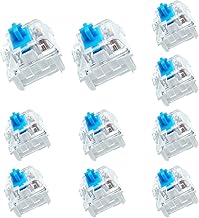
Users who want the basic mechanical keyboard experience without the scam premium.
- Provides the definitive clicky mechanical feel
- Extremely low cost per switch
- Simple plug-and-play replacement for most hot-swap boards
Walk into any keyboard forum or subreddit and you'll find endless threads comparing Gateron Brown to Cherry Clear, Holy Pandas to Boba U4Ts. It's a labyrinth of subjective nonsense. Here's the brutal truth nobody wants to say: For 99% of users, switch choice is irrelevant. The differences are so subtle they're swamped by variables that actually matter—keycap profile, desk mat thickness, typing technique, even the humidity in your room.
The industry lies about this. They need you to believe that spending $150 on a set of "premium" switches will transform your typing experience. It won't. It can't. The mechanical advantage—the actual performance benefit over a cheap membrane board—is achieved with the most basic mechanical switch. Everything beyond that is diminishing returns so steep they're vertical. You're paying for novelty, not utility.
Most people get this wrong. They think collecting switches is a hobby. It's not. It's consumption disguised as craftsmanship. You're not a connoisseur; you're a mark.
The Real-World Performance Lie Nobody Talks About
Let's talk about the supposed performance benefits: speed, accuracy, reduced fatigue. It's all marketing fluff. There is no credible, repeatable study that shows a $2 tactile switch makes you type faster or more accurately than a $0.50 linear switch or even a well-designed scissor-switch laptop keyboard over the long term. Your speed is limited by your cognitive processing and motor skills, not a 2mm plastic bump.
The fatigue argument is even more laughable. Lighter spring weights are often touted as less fatiguing. Sure, maybe. But the real cause of typing fatigue is poor posture, a terrible chair, and a desk at the wrong height—things we've covered in our piece on chair planned obsolescence and standing desk myths. Spending $300 on switches while your chair is destroying your spine is like putting racing tires on a car with no engine. You're optimizing the wrong thing.
Why Lubing Switches Is The Ultimate Waste Of Time
Ah, lubing. The sacred ritual of the keyboard hobbyist. You'll spend 4-6 hours of your life meticulously applying grease to 70 tiny plastic components to achieve a marginally smoother press and a slightly different sound. This is not a performance modification. This is a craft project. It's therapy with extra steps.
In real use, after two weeks of typing, the difference between a lubed and unlubed switch is imperceptible to anyone but the most delusional enthusiast. The process doesn't make you a better typist. It doesn't increase your WPM. It makes your keyboard feel slightly different for a short period, after which your brain normalizes it. The entire practice exists to give the hobby a sense of depth and skill where none is needed. It's busywork for people who've been sold the tactile switch scam and need to believe their investment has meaning.
This is overrated. Full stop.
The Sound Test Trap: Audiophile Nonsense For Your Fingers
The ASMR keyboard sound test is the cornerstone of the scam. A carefully mic'd recording in a sound-treated room makes a switch sound like a revelation. But your keyboard doesn't live in a vacuum. It sits on your desk, in your room, with ambient noise. The sound you hear in the video is not the sound you get at your desk. It's a fantasy.
Furthermore, the quest for the "perfect sound" leads people to buy expensive desk mats, foam mod their keyboard cases, and use specific keycap materials—all to alter an acoustic profile that only they care about. It's the audio equivalent of spending thousands on acoustic panels for a untreated room; you're addressing 5% of the problem with 95% of the budget.
The industry loves this because it's unquantifiable. You can't prove the sound is "better," so you can never be wrong. It's pure, subjective hype.
The Tactile Switch Scam Myth That Needs To Die
Let's tackle the biggest myth head-on: "Tactile switches help you avoid accidental keypresses and increase accuracy." This is the foundational lie of the entire tactile marketing push. It's repeated so often it's taken as gospel. It's also complete bullshit.
Think about it. The tactile bump occurs partway down the keystroke. By the time you feel it, you've already committed to the press. It does not help you stop mid-press. It's a notification, not a prevention system. Your accuracy is determined by your muscle memory and key spacing, not feedback you receive after the decision is made. This myth persists because it sounds logical, but in the physics of typing, it's meaningless. It's a just-so story invented to justify the premium of tactile over linear switches.
This doesn't work. You've been told it does because it sells more expensive, "feature-rich" switches. It's the cornerstone of the tactile switch scam.
What Actually Matters For A Good Typing Experience
If switch type is largely irrelevant past the basic mechanical threshold, what should you care about? Here's the actual hierarchy of keyboard impact, from most to least important:
- Ergonomics & Layout: A properly positioned keyboard (tented, split, etc.) has orders of magnitude more impact on comfort and long-term health than any switch. Your wrists don't care about the stem material.
- Keycap Profile & Material: The shape and texture of the keycap you actually touch affects feel far more than the hidden switch underneath. A good PBT OEM profile cap on a cheap switch feels better than a crappy ABS cap on a gold-plated spring.
- Keyboard Firmware & Programmability: The ability to remap keys, create layers, and disable caps lock is a genuine productivity boost. No switch can offer that.
- Build Stability: A keyboard that doesn't flex or wobble feels solid and premium. This is about the case and plate, not the switches.
- Connection Reliability: Wireless dropouts or wired latency will ruin your experience faster than any switch characteristic. This is why chasing insanely high polling rates is often pointless.
Notice how "switch stem tactile bump shape" isn't on the list? That's because it belongs in the bin with other marketing fluff.
How To Actually Spend Your Keyboard Budget (Without The Scam)
Stop obsessing over switches. Here’s a financially sane approach:
- Pick a layout you'll use. 65%, 75%, TKL—this matters for desk space and muscle memory.
- Buy a board with decent programmability (VIA/QMK support). This is a real feature.
- Get a good set of PBT keycaps. They'll outlast the keyboard and improve feel immediately.
- Spend the absolute minimum on switches. Buy the cheapest mechanical switches that aren't broken. For 99% of people, a bag of Gateron Yellows or Reds is the end of the journey.
- Take the hundreds of dollars you just saved and invest in your actual workspace. A better monitor arm, proper lighting, or even a contribution to your retirement account will yield infinitely more life satisfaction than the difference between a Zealio and a Kalih Box Jade.
This is the real issue: the keyboard community has misplaced priorities. They'll agonize over a 5g spring weight difference while typing on a folding table in a dark room. It's absurd.
Final Verdict: Skip It
The tactile switch scam is one of the most successful, and stupidest, marketing feats in the desk peripheral world. It has convinced an entire generation that the path to typing nirvana is through endless consumption of marginally different plastic components.
Skip it.
Don't buy into it. Don't watch the videos. Don't join the group buys. Take the money, the time, and the mental energy you were going to pour into this black hole of diminishing returns and apply it to something that actually improves your work or life. Your keyboard is a tool. The moment you start treating it like a jewel, you've lost the plot. The tactile bump is a gimmick, the sound is a parlor trick, and the entire premium switch market is a house of cards built on subjective nonsense. You're better than this. Now go use a keyboard, don't worship one.
Frequently Asked Questions
Are tactile switches really a scam?
Yes, the marketing and premium pricing around high-end tactile switches is largely a scam. The performance differences are negligible in real-world use, and the touted benefits like increased accuracy are not supported by evidence. The industry sells nuance that the human brain ignores after a short acclimation period.
What's the best mechanical keyboard switch for typing?
The 'best' switch is the cheapest one that works. For 99% of typists, a basic linear or tactile switch from Gateron or Kailh provides 95% of the mechanical keyboard benefit. Spending 5-10x more on 'premium' switches yields no tangible typing improvement. Focus your budget on ergonomics, keycaps, and layout instead.
Does lubing switches make a noticeable difference?
For a brief period, yes. In long-term daily use, the difference becomes imperceptible as your brain adapts. Lubing is a hobbyist activity for altering sound and initial feel, not a meaningful performance upgrade. The hours spent lubing are almost never justified by the resulting marginal change.
Should I buy expensive switches for my first mechanical keyboard?
Absolutely not. Start with the most affordable switches possible. Your untrained perception won't appreciate the nuances, and you'll likely develop a preference unrelated to price. Expensive switches are for collectors and hobbyists deep in the scam, not for users seeking a better typing tool.

Written by
From bias lighting behind your monitor to smart RGB ecosystems, Leon knows exactly how to light a room for productivity during the day and gaming at night.
Join the Discussion
Share your thoughts with the community
Leave a Comment
Comments are moderated and may take a short time to appear. Links are not permitted.