Sound Absorbing Wall Art Buying Guide for 2026
Most wall art sold as acoustic is a printed canvas with a foam backing and an NRC near 0.05 — the same as drywall. Here's the thickness, coverage, and mounting math that separates real absorbers from decorative ones, priced honestly from $35 DIY to $600 architectural slats.
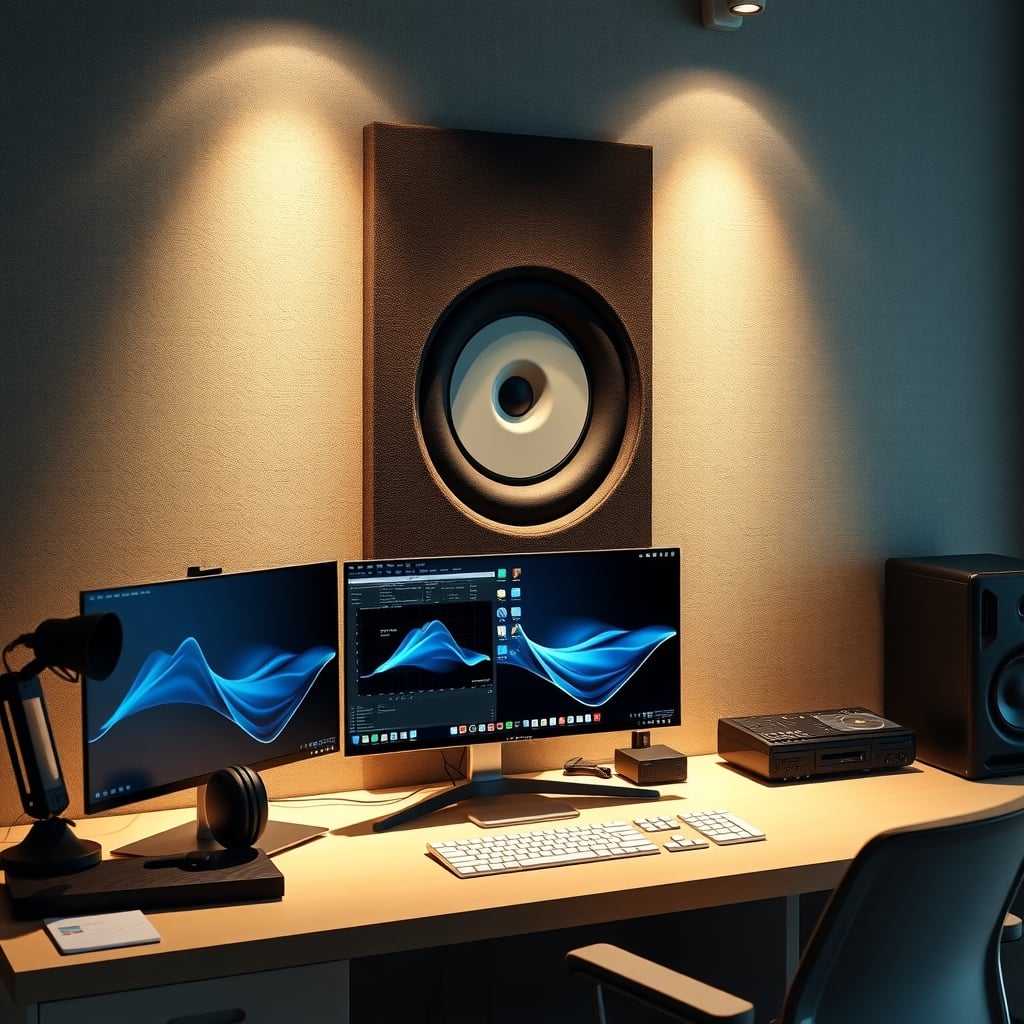
Most people buy art that looks right, spot the word acoustic somewhere in the listing, and assume the wall behind their desk is now treated. It usually isn't. A printed canvas stretched over a pine frame has a Noise Reduction Coefficient of roughly 0.05 — functionally identical to the drywall it hangs on. You bought a picture. That's a fine purchase, but it isn't a fix.
The short answer for real sound absorbing wall art: look for a panel at least 2 inches (50 mm) thick, built around a mineral wool, fiberglass, or dense recycled-cotton core, wrapped in fabric, sized 24x24 in or larger, hung 1–2 inches off the wall, and covering roughly 15–25% of the room's wall surface. Under an inch of thickness, you're paying decoration prices for a decoration — which is legitimate, as long as nobody told you it would kill the echo.
Everything below is about where that line actually sits, what each price tier genuinely buys, and how to keep the room looking like a room instead of a vocal booth.
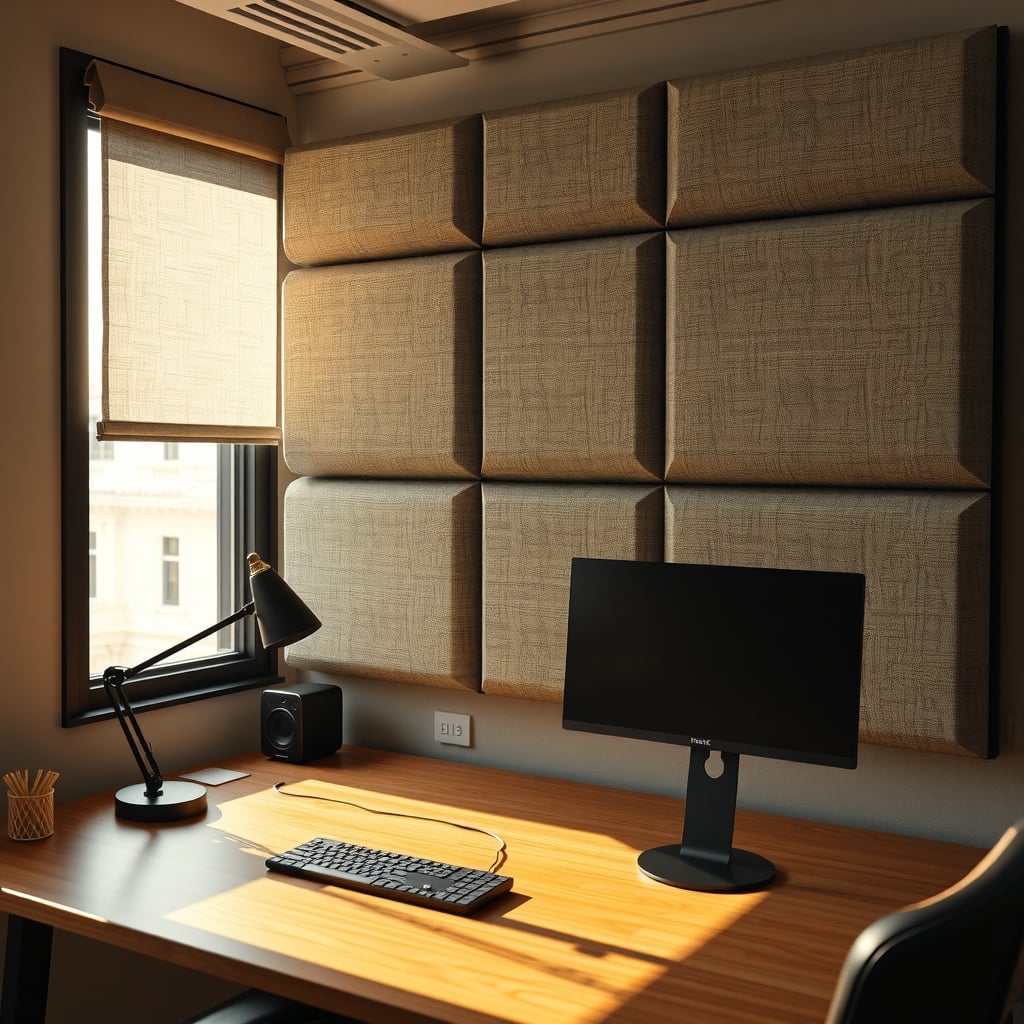
Why Most Sound Absorbing Wall Art Does Almost Nothing
The physics here is simple. Sound has to enter a porous material and lose energy as friction against fibers. A hard, printed, sealed surface reflects it straight back into the room. That's the whole mechanism, and it's why a $90 printed canvas and a $90 framed poster behave the same way: both are walls with a picture on them.
The giveaway is always the spec sheet. Reputable acoustic products publish an NRC figure tested to ASTM C423 and, in commercial contexts, a fire class to ASTM E84. If a listing describes the piece as acoustic, sound dampening, or studio grade but never prints a number, treat it as decor. That's not cynicism — it's just how the category is marketed.
Two more things worth knowing before you spend anything:
Absorption is not soundproofing. Panels reduce reflections inside your room, which is why calls sound less hollow and your mic picks up less boxiness. They do nothing about noise coming through a shared wall or under a door. That requires mass and decoupling, not fabric. If your actual problem is a neighbor, this entire category is the wrong purchase.
Foam wedges are the weakest option per dollar. Cheap polyurethane foam is thin, degrades in sunlight, and often carries no fire rating — a real concern if you're hanging it near a power strip or in a room you leave unattended. It also looks like a studio from 2009. There are better ways to spend the same money, and we'll get to them.
The Three Numbers That Decide Everything
Ignore the adjectives on the box. Three numbers determine whether a panel does anything.
NRC, or Noise Reduction Coefficient. A single averaged number from 0 to 1.0 describing how much mid-frequency sound the material absorbs versus reflects. A painted drywall wall is about 0.05. Heavy curtains are maybe 0.15–0.25. A proper 2-inch fabric-wrapped absorber typically lands between 0.85 and 1.05. Yes, above 1.0 — the ASTM C423 method has an edge-diffraction quirk that lets large panels exceed unity. If you see a number at or above 0.85, it's a real absorber.
Thickness, in millimeters, because thickness sets which frequencies get absorbed. This is the part the marketing glosses over. Roughly: a 25 mm (1 in) panel absorbs well down to about 500 Hz, a 50 mm (2 in) panel reaches roughly 250 Hz, and a 100 mm (4 in) panel starts touching 125 Hz. Human voice fundamentals sit around 85–255 Hz, with consonants up in the 2–8 kHz range. Thin panels clean up the bright clatter of a hard room but leave the low muddiness — the thing that actually makes your voice sound like it's in a bathroom — largely untouched.
Coverage, as a percentage of total room surface. This is where most desk setups fail, not on product choice. A 10 x 10 x 8 ft office has roughly 520 sq ft of wall, floor, and ceiling area. Six 2 x 4 ft panels is 48 sq ft — about 9% coverage. That's a modest improvement, noticeable but not transformative. For a treated-sounding room, aim for 15–25% coverage of the surfaces parallel to your ears, and prioritize the walls you face and the ones directly behind you.
If you want to sanity-check the math, the Sabine equation is RT60 = 0.161 x V / A, where V is room volume in cubic meters and A is total absorption in sabins (surface area x coefficient). You don't need to run it. You do need to understand that doubling absorption roughly halves reverb time, and doubling absorption means roughly doubling panel area — not buying a more expensive version of the same size.
Thickness and Air Gap: The Physics Nobody Prints on the Box
Hanging a panel flat against the wall is the default and it's leaving performance behind. A porous absorber works best when sound can enter from both the front and the edges. Mount a 1-inch panel on a 1-inch standoff and its useful band shifts downward, behaving closer to a 2-inch flush panel through the midrange. That's why every commercial install uses Z-clips, French cleats, or offset frames rather than flush adhesive.
The practical version: buy 2-inch panels and mount them on a 1–2 inch air gap. That combination covers voice fundamentals and the mid-band where small-room boxiness lives, and it costs you a few dollars in hardware. If you're stuck with 1-inch panels because of budget or aesthetics, at minimum get them off the wall.
Corners and wall-ceiling junctions are worth a mention because they collect low-frequency pressure. A single deep panel straddling a corner does more for 100–200 Hz boominess than three thin panels in the middle of a flat wall. It also looks odd, so most people skip it — a fair trade if your room is already close.
One more spec worth checking if the room is commercial, rented, or anywhere near a hallway: fire class. Class A to ASTM E84 is the standard you'll see quoted. Loose foam tiles frequently aren't rated at all, and fabric-wrapped mineral wool almost always is.
Five Kinds of Sound Absorbing Wall Art, Priced Honestly
Here's the category broken down by what you're actually buying, with realistic 2026 street prices and the honest reason to walk away from each.
Best overall: 2-inch fabric-wrapped panels printed like art, roughly $120–200 per 24 x 36 in
This is the sweet spot. A rigid 50 mm mineral wool or fiberglass core, a printed or dyed fabric face, a clean edge, and a published NRC in the 0.85–1.05 range. Dye-sublimation printing on acoustically transparent fabric gives you real image quality — not the slightly milky look of a canvas print — and the fabric weave does double duty by absorbing the highest frequencies that make small rooms feel harsh. Three to six of these in a 10 x 10 ft office is a genuine change you can hear on a call recording. The trade-off: rigid cores are heavy, so you need real anchors, and printed fabric can fade if the panel sits in direct afternoon sun. Skip these if you're in a rental with a strict no-drilling clause or if your room already has carpet, a sofa, and heavy curtains — you may not need them.
Best budget: DIY frame plus mineral wool plus printed fabric, roughly $35–60 per 24 x 24 in
A 1 x 2 in lumber frame, a batt of mineral wool, a layer of acoustically transparent fabric, and a staple gun. This is the highest performance-per-dollar in the entire category by a wide margin, and it lets you use fabric that actually matches your room instead of picking from eight stock colors. Depth is your choice, which means you can go 4 inches and get real low-frequency absorption for the price of a takeout dinner. Downside is honest: the edges look homemade unless you take care with the corners, mineral wool needs gloves and a dust mask, and you need a staple gun and about an hour per panel. Skip this if you don't own a drill or you want something that reads as art rather than craft.
Best premium: wood slat over felt, or deep 4-inch framed absorbers, roughly $250–600 per 24 x 48 in
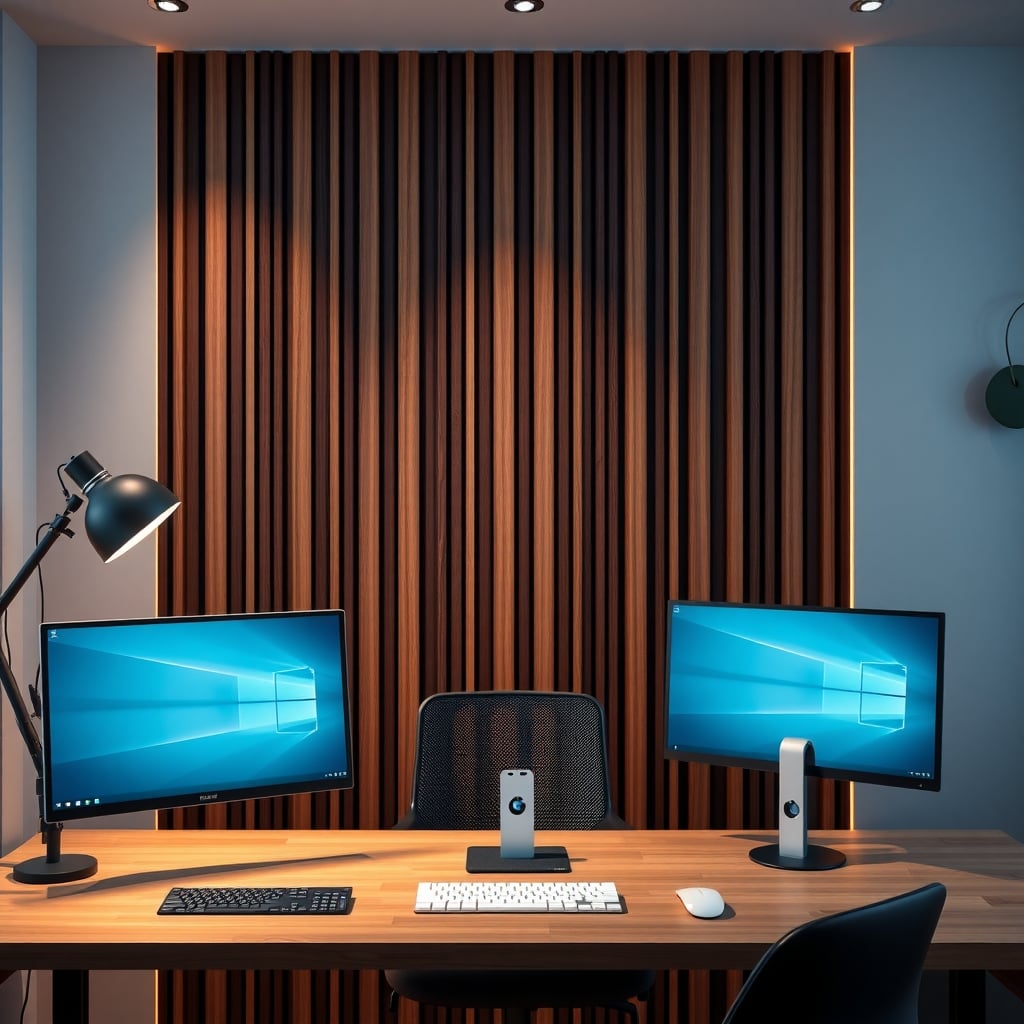
Slatted panels — thin wood battens over a PET felt backing — are the architectural answer, and they photograph beautifully behind a desk. Be clear about what you're buying: slats diffuse high frequencies off their face while the felt behind absorbs through the gaps, so the absorption curve is peaky rather than broadband. Published NRC values cluster around 0.30–0.70 depending on slat width, gap, and felt thickness, and they are not the same thing as a flat 0.95 absorber. For a warm-looking room with a mild brightness problem, they're excellent. For a voiceover booth, a plain 2-inch absorber is better and cheaper. Skip these if your problem is low-end mud — they won't fix it.
Best for renters and small rooms: 24 mm PET felt panels, roughly $120–180 for a set
Recycled PET felt in hexagons, rectangles, or shaped tiles is the most renter-friendly option. At 24 mm with even a small air gap, published NRC figures typically land around 0.40–0.55 — genuinely useful, well above the 9 mm decorative version that's sold mostly for color. They're light enough for adhesive strips, come in matte, dusty colorways that suit a desk wall, and can be arranged as an actual composition rather than a grid. The limit is the low end: below roughly 250 Hz they thin out, so a room with a deep boom won't be fixed. Skip these if you need low-frequency control or if you hate visible seams.
Best for a streaming or podcast backdrop: one large 48 x 36 in printed absorber behind the mic, roughly $180–300
If you're on camera, the wall behind you is doing two jobs at once. A single large printed absorber kills the slapback that makes USB mics sound hollow and gives the frame a deliberate background instead of a blank wall. Size beats quantity here — one 48 x 36 in panel absorbs more than three 16 x 16 in ones and reads as intentional composition. Pair it with two smaller panels on the side walls at mouth height. Skip this if your streaming room already has a bookshelf and a rug behind you; soft furnishings are absorption, and you may be solving a problem you don't have. If the mic itself is picking up desk thumps, that's a different fix — see our guide to podcast mic isolation that doesn't overspend.
Side-by-Side: What Each Type Actually Delivers
Type Typical price (24 x 24 equivalent) Core and thickness Published NRC Low-frequency reach Reads as Printed canvas, foam-backed $40–90 Foam, 3–13 mm 0.05–0.15 None Gallery art PET felt tiles, thin $60–120 for a set Recycled felt, 9 mm 0.15–0.30 None Scandinavian texture PET felt panels, thick $120–180 for a set Recycled felt, 24 mm + gap 0.40–0.55 To about 250 Hz Soft, sculptural Fabric-wrapped mineral wool $120–200 Rigid core, 50 mm 0.85–1.05 To about 250 Hz Gallery canvas Wood slat over felt $200–450 (24 x 48) Felt + battens, 22–24 mm 0.30–0.70, peaky Mid-band only Architectural DIY frame + mineral wool $35–60 Mineral wool, 50–100 mm 0.90–1.10 To about 125 Hz at 100 mm Depends on your fabricRead the table by column, not by row. The price column tells you what the market charges; the NRC and low-frequency columns tell you whether it will change what you hear. Anything in the bottom three rows will move a room. Anything in the top two rows will move your mood.
Color, Texture, and the Visual Job Your Panels Are Doing
Acoustic panels fail aesthetically for one reason: people treat them as equipment and hang them like equipment. A 2 x 4 ft rectangle in the middle of a wall at eye level looks like a filing cabinet. You don't want that above your desk.
Some rules that hold up. Matte fabric reads as art; anything with sheen reads as gear. Deep tones — charcoal, forest, oxblood, warm terracotta — visually recede, hide the shadow gap of an offset mount, and make a room feel calmer, which is convenient because dark fabric also shows less dust than off-white. Light neutrals bounce more light back and will brighten a north-facing room, but they make every seam and every slightly uneven corner visible.
Texture does more work than pattern. A visible weave or a soft bouclé face absorbs the highest frequencies and gives the panel a surface that reads as textile rather than print. A flat graphic print on smooth fabric looks sharp and modern but can read as a poster once it's larger than about 30 inches.
Composition matters more than you'd think. One large panel beats four small ones both acoustically and visually. If you're using a set, asymmetric arrangements with 2–4 inches of wall between pieces look intentional; edge-to-edge grids look like a hotel conference room. And because these panels are matte and light-absorbing, they interact with your desk lighting — if you're already wrestling with glare, our notes on ambient office lighting that won't fight your monitor are worth reading before you commit to a dark wall of panels.
Matching the Panel to the Room You Actually Have
A spare-bedroom office with a hard floor, painted drywall, and one window is the worst case and the most common. Here, 2-inch fabric-wrapped panels at 15% coverage will be a night-and-day change on calls. Six 24 x 36 panels is a realistic number, not an upsell.
An open-plan corner with carpet and soft furniture is a much easier room. Two panels behind the monitor and one behind you is often enough. Before buying anything, clap once in the middle of the room. A short, dry clap means you're fine. A clap that rings back at you means reflections, and reflections are what absorption fixes.
For a streaming setup, prioritize the wall the camera sees and the two side walls at mouth height. Placement is genuinely more important than brand here — a well-placed cheap panel beats a badly placed expensive one every time. We go deeper on that in acoustic panel placement that actually fixes room echo.
For voice recording, treat the wall you face and the wall behind you before anything decorative. Getting the mic and desk geometry right first will save you money on panels — our breakdown of podcast desk layout mistakes that ruin your audio covers the parts that aren't wall-mounted.
Three Mistakes That Waste the Money
Buying by look, then expecting a sound change. The most common failure is a $150 printed canvas with a thin foam core, chosen because it matched the room. It will match the room beautifully and change nothing. The fix: if the listing has no NRC number, buy it as art and budget separately for absorption.
Clustering everything behind the monitor. Sound bounces off the wall behind you and the side walls at least as much as the one you face. Spreading four panels across three walls does more than stacking four on one. The fix: cover the first reflection points and the wall behind your chair before you add a second panel to the wall in front.
Believing the word soundproof. Nothing you hang on a wall stops noise travelling through a shared wall, a door gap, or a floor. Absorption changes what happens inside the room; isolation changes what crosses the boundary. The fix: if the complaint is a neighbor or street noise, spend on sealing gaps and adding mass, not on fabric panels.
Who Should Buy What — and Who Should Skip It
Buy 2-inch fabric-wrapped panels if you take calls all day in a hard-surfaced room and want the wall to look deliberate. It's the only tier where art and acoustics genuinely converge.
Build your own if your budget is under $150 total. Four DIY panels at 2 inches deep will outperform one $200 retail panel, and you get to choose the fabric.
Buy thick PET felt if you rent, can't drill, or want a soft, low-contrast wall. Accept that the low end stays where it is.
Buy slatted panels if you want architectural interest and your room only has a mild brightness problem. Don't buy them expecting studio numbers.
Skip the entire category if your room already has carpet, a sofa, bookshelves, and curtains — you may be at 15% absorption without a single panel, and a clap test will tell you in three seconds. Skip it too if the real problem is a neighbor's bass or traffic noise, or if you're shopping for panels under 10 mm thick because they're cheap. At that thickness you're buying color.
Bottom Line
The honest verdict for most desk setups: buy three to six 2-inch fabric-wrapped panels, 24 x 36 or larger, with a published NRC above 0.85, and hang them on a 1–2 inch standoff across at least two walls. Budget $400–700 for a small home office done properly, or $150–250 if you're building them yourself with mineral wool and fabric you actually like. That's the purchase that changes how your room sounds.
Everything below about $100 per panel in this category is decoration, and there's nothing wrong with decoration — just don't buy it expecting reverb to drop. The spec sheet tells you which one you're holding.
Frequently Asked Questions
Does sound absorbing wall art actually work?
It works if the panel has a porous core at least 25 mm thick and a published NRC above roughly 0.60. A printed canvas over a wooden frame has an NRC around 0.05, about the same as drywall, so it behaves as decoration. The material and thickness matter far more than the artwork printed on the face.
How many acoustic panels do I need for a home office?
Aim for 15 to 25 percent coverage of the room's wall surface, prioritizing the wall you face and the wall behind your chair. A 10 x 10 x 8 ft office has about 520 sq ft of total surface, so six 2 x 4 ft panels is roughly 9 percent — a modest improvement. Eight to twelve panels gets you into the range where reverb noticeably drops.
What does NRC mean on an acoustic panel?
Noise Reduction Coefficient, a 0 to 1.0 average of how much mid-frequency sound a material absorbs versus reflects, tested to ASTM C423. Painted drywall is about 0.05, heavy curtains 0.15 to 0.25, and a 2-inch fabric-wrapped absorber typically 0.85 to 1.05. Values slightly above 1.0 are normal because of an edge-diffraction quirk in the test method.
Do acoustic panels block noise from neighbors?
No. Absorption reduces reflections inside your own room, which is why calls sound less hollow. Stopping noise that crosses a shared wall requires mass and decoupling — added drywall, resilient channels, sealed gaps. Panels on the wall will not measurably reduce sound coming through it.
Should acoustic panels be mounted flush to the wall?
No, mount them on a 1 to 2 inch air gap using Z-clips, French cleats, or an offset frame. The gap lets sound reach the panel edges, which pushes absorption lower in frequency. A 1-inch panel on a 1-inch gap behaves closer to a 2-inch flush panel through the midrange.
What is the best acoustic panel thickness for voice?
50 mm (2 inches) covers most of the useful range for human voice, absorbing down to roughly 250 Hz while handling the 2 to 8 kHz consonants that make hard rooms sound harsh. Go to 100 mm (4 inches) if low-end boominess is the specific problem, and treat it as decorative only below 25 mm.
Written by
GlowRig Editorial researches and writes practical guides about desk setups and home office gear. Our articles are produced with the help of AI research tools and are reviewed for accuracy against manufacturer specifications and public user feedback. We may earn a commission from affiliate links, which never affects our recommendations.
Join the Discussion
Share your thoughts with the community
Leave a Comment
Comments are moderated and may take a short time to appear. Links are not permitted.