Chair Ergonomics Science 2026 Ultimate Guide
Forget the twelve-step adjustment guides and the $2000 mesh thrones. Real chair ergonomics science in 2026 is about dynamic movement and avoiding injury traps, not achieving a single perfect pose. We're dismantling the industry's biggest lies.

I need you to stop thinking about your chair as a throne of perfect posture. You’re not a statue, and your spine isn’t a museum exhibit that needs perfect 90-degree glass casing. The way we talk about chair ergonomics science in 2026 is fundamentally broken, poisoned by marketing departments selling you a solution to a problem they invented. I’ve watched people contort themselves into rigid, miserable positions because a chart on a website told them to, only to develop new, more creative aches. The industry lies about this. It’s not about holding a pose; it’s about facilitating safe, constant movement. Let’s burn the dogma to the ground.
The real problem isn't your $200 office special from a big-box store. It's the billion-dollar ergonomic industrial complex convincing you that you need seventeen levers, five-dimensional lumbar support, and a degree in biomechanics just to sit down. You're sold on the idea of a "fit" like it's a bespoke suit, when the truth is your body wants variety, not confinement. Most people get this wrong. They chase the spec sheet—tilt tension! synchronous tilt! waterfall edge!—and end up with a high-tech torture device that feels ergonomic in the showroom for five minutes but becomes a prison over an eight-hour workday.
Widespread user feedback is brutally clear: the chairs with the most aggressive, pronounced lumbar supports are the ones most frequently returned or complained about. Why? Because they dictate a single spinal position. If your unique curvature doesn't match the hard plastic knob they decided was "universal," you lose. Every time. This is a known issue for long-term use, where that persistent pressure point goes from "supportive" to "aggressively annoying" to "genuinely painful."
Why The Perfect Posture Myth Is Actively Harmful
This is the core lie that needs to die. The entire concept of maintaining a perfect, upright 90-degree posture all day is not just unrealistic; it's physiologically stupid. Your body is designed to move. Enforcing static alignment is how you create stiffness, reduce circulation, and actually increase disc pressure in your lower back over time.
The industry standard diagram—feet flat, knees at 90, back at 90, elbows at 90, monitor at eye level—is a snapshot, not an instruction manual. Treating it as a permanent state is like seeing a photo of someone mid-sprint and deciding to hold that pose for your entire workday. Your muscles fatigue, you slouch, and then you feel guilty for "failing" at ergonomics. This is overrated. The goal isn't to hold a pose; it's to have a chair that allows you to move freely between many different, non-harmful positions. Reclining slightly (110-135 degrees) actually reduces lumbar disc pressure compared to the "perfect" 90 degrees, according to peer-reviewed studies. But that doesn't sell $1500 chairs, does it?

The Real Science of Chair Ergonomics in 2026
Premium Pick
- High performance
- Premium build
Forget the adjustment porn. Real chair ergonomics science in 2026 is brutally simple: it’s the study of how to sit for long periods without developing pain or injury, and the unanimous conclusion from actual research is that movement trumps any specific alignment. Your chair should be a tool for movement, not a restraint.
The most important feature isn't lumbar support—it's the ability to easily and intuitively change your position. Can you recline back smoothly without feeling like you're fighting a spring? Can you perch on the edge? Can you sit cross-legged for a few minutes (yes, you can, despite what the posture police say) without the armrests digging into your thighs? This is the real issue. A chair that locks you into one "ideal" position is worse than a basic stool that forces you to shift and adjust naturally. We’ve become so obsessed with micromanaging our spines that we’ve outlawed the body's natural tendency to fidget, which is its own built-in ergonomic system.
Lumbar Support Is The Most Overrated Feature
Let's be direct: the aggressive, adjustable lumbar bulge is a marketing gimmick that has conned the entire industry. For a small subset of people with specific existing issues, it might be useful under guidance. For the other 90% of us, it's an uncomfortable prod that either does nothing or actively creates a pressure point.
Your lower back has a natural inward curve (lordosis). A good chair seat pan should allow your pelvis to tilt slightly forward (anterior pelvic tilt), which naturally maintains that curve. If your seat is forcing your pelvis to roll backward, no amount of lumbar knob-turning will fix it—you're just jamming a plastic lump into your spine to compensate for a bad foundation. This doesn't work. In real use, most adjustable lumbar supports are either set incorrectly (pushing too hard) or ignored entirely. The money spent on engineering that complex mechanism would be better spent on higher-quality foam that doesn't bottom out after 12 months.

Where Your Money Actually Matters (And Where It Doesn't)
You're wasting money on gimmicks like "4D" armrests that flip, pivot, slide, and ascend. In practice, you set them once and never touch them again. The extra $300 for that? Skip it. You're also wasting money on ultra-breathable mesh backs if you don't run hot; a good fabric will do the same job and be more comfortable.
Where your money does matter is in the core mechanical components: the cylinder, the tilt mechanism, and the base. A wobbly cylinder or a tilt that jerks and sticks will ruin your experience every single day. This is where the no-name Amazon specials fail catastrophically. The mechanism should be smooth, silent, and robust. The seat foam should be high-density and not turn into a pancake within a year—a universal failure point for budget chairs that users consistently report. Pay for core integrity, not feature-checklist bingo.
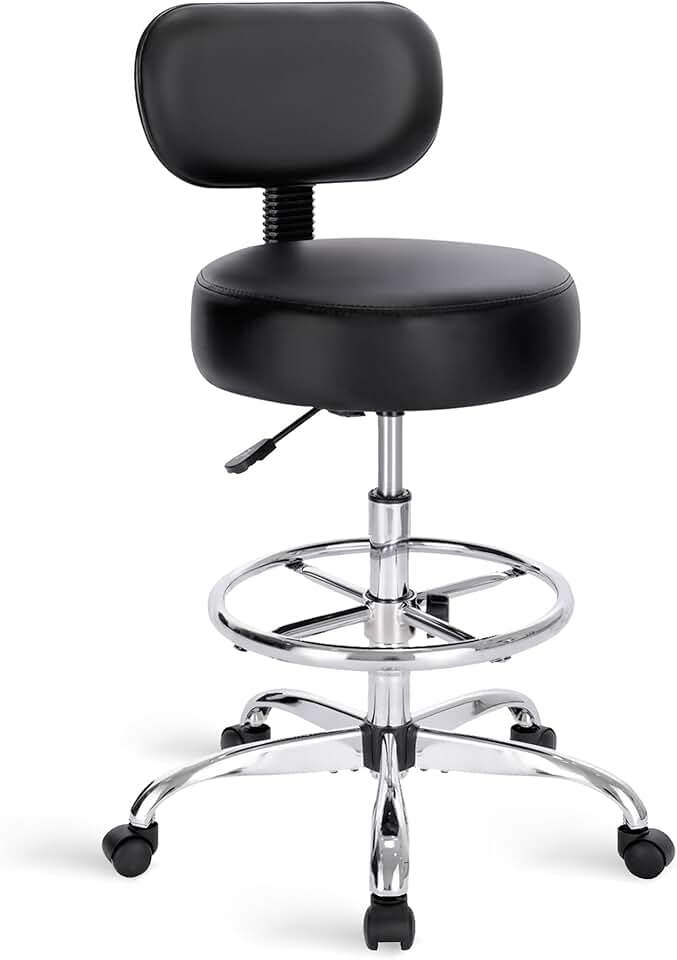
For a specific, budget-conscious solution that gets the fundamentals right, consider a Primy Drafting Chair. It cuts the nonsense common in low-end chairs by offering a simple, sturdy build, a decent seat, and crucially, a tall range that works well with standing desks—a common pain point where standard chairs fail. It's not a magic bullet, but it understands the assignment: provide a stable, adjustable perch without overcomplicating it. For a more detailed look at how your desk impacts your health, consider the hidden standing desk risks you're likely ignoring.
The One Adjustment Nobody Talks About (But Should)
Seat pan depth. This is the single most critical and most ignored adjustment. If the seat is too long, it presses into the back of your knees, cutting off circulation and forcing your pelvis to roll back, destroying your lower back alignment. If it's too short, you lose thigh support and feel perched. You should be able to sit back fully with about 1-3 inches between the seat edge and the back of your knee. Getting this wrong makes every other adjustment—lumbar, armrests, headrest—completely irrelevant. Most people get this wrong because they never adjust it; they just live with the factory setting.
The Biggest Mistake: Chasing the Hype, Ignoring Your Body
The number one lesson learned from years of reviewing this stuff? People buy for specs and brand hype, not for their own anatomy. They buy the chair their favorite streamer uses, or the one with the most tech jargon in the listing, without ever considering their own height, weight, or sitting habits.
A chair that's perfect for a 6'3" user will be a nightmare for someone who's 5'4". That deeply contoured seat designed for "maximal support" might be torture if you have wider hips. This is overrated. The best chair is the one you can sit in for an hour and forget it's there. Not the one that constantly reminds you of its "support" with firm pressure points. Before you buy anything, if possible, sit in it. Not for five minutes. For at least thirty. Your body will tell you the truth long before any reviewer can.
Also, don't fall into the trap of thinking a chair alone will fix pain caused by a horrible monitor position or a completely sedentary lifestyle. It's one piece of a system, and a flawed one at that. Your entire desk setup can be a minefield; understanding common home office layout pitfalls is also crucial.
Final Verdict: Actually Good, But Not For The Reasons You Think
Is investing in a decent chair worth it? Actually good. But not because it will grant you perfect posture. It's worth it because a well-built chair with a smooth recline and solid construction will last a decade, feel consistently good, and—most importantly—get out of your way and let you move.
Should you spend $1500 on the latest ergonomic marvel with a sci-fi name? Skip it. That's paying for marketing theater. The law of diminishing returns hits hard after about the $500-$700 mark for standard chairs. You're buying marginal gains and aesthetic finishes, not revolutionary comfort.
The real secret of chair ergonomics science isn't in the chair at all. It's in the timer on your phone reminding you to stand up, walk, stretch, and sit differently every thirty minutes. Your chair is just the temporary landing pad between movements. Buy a good landing pad, not a gilded cage.
Stop treating your seat like a prescription. Start treating it like a tool. And for God's sake, stop staring at those posture diagrams.
Frequently Asked Questions
Is the 90-degree sitting posture actually bad for you?
Yes, holding a static 90-degree posture all day is terrible. It's a snapshot, not a sustainable position. Your body needs movement. Research shows slightly reclining (110-135 degrees) actually reduces spinal disc pressure. The goal is to move between various positions, not hold one.
Are expensive ergonomic chairs with many adjustments worth it?
Mostly no. Diminishing returns hit hard after the mid-range. You're often paying for complex adjustments (like 4D armrests) you'll set once and ignore. Prioritize core build quality, smooth tilt, and seat comfort over a long feature checklist.
What's the single most important chair adjustment?
Seat pan depth. If it's too long, it cuts off circulation behind your knees and ruins pelvis alignment. If it's too short, you lose support. Getting this right is foundational; getting it wrong makes all other adjustments pointless.
Can a good chair fix my back pain?
A bad chair can definitely cause pain, but a good chair is only one part of the solution. It won't fix pain caused by overall sedentariness, poor monitor setup, or lack of movement. Think of it as damage mitigation, not a cure. Consider broader desk health risks too.
Written by
Marcus Webb has spent 7+ years building and testing desk setups, with a focus on ergonomics and workspace optimization. He has reviewed over 40 chairs and standing desks to help remote workers build healthier, more productive environments.
Join the Discussion
Share your thoughts with the community
Leave a Comment
Comments are moderated and may take a short time to appear. Links are not permitted.