The Cable Management Scam You're Still Falling For
The entire cable management industry is built on selling you solutions to a problem they exaggerate. We've seen every viral product fail in real setups. Here's what you actually need—and what's pure marketing hype.

The biggest mistake people make when tackling their desk setup isn't a lack of effort—it's believing the cable management scam sold by influencers and tech brands. You're told you need intricate systems, specialized trays, and modular organizers to achieve a "clean" look. That's marketing nonsense. The reality is most commercial cable management solutions are designed for Instagram aesthetics, not real-world durability or practicality. They fail under the basic stress of daily use, turning your expensive setup into a tangled mess within months. The industry profits from your insecurity about visible wires, convincing you to buy products that solve imaginary problems.

You've watched the videos: pristine desks with zero visible cables, labeled ties, and color-coordinated sleeves. It's a lie. That setup lasts exactly as long as the photo shoot. In real use, you add a new device, swap a keyboard, or need to troubleshoot. The rigid system collapses. You're left fighting against the very organization you paid for. This isn't about being messy—it's about rejecting solutions that prioritize form over function. Most people get this wrong because they're sold a fantasy, not a functional strategy.
Why The "Perfectly Hidden" Cable Myth Needs To Die
This is overrated. The obsession with making every single wire invisible is a waste of time and money. The industry lies about this by showcasing setups that are literally staged and non-functional. In a real working environment—especially a YouTuber setup where gear changes weekly—absolute invisibility is impossible. Attempting to achieve it leads to three major failures: poor airflow around power bricks, impossible access for troubleshooting, and excessive tension on cable connectors that causes premature wear.
Based on widespread user feedback, the most common point of failure for these "hidden" systems is the under-desk tray. Users consistently report that trays fill with heat-generating power supplies, causing thermal throttling and reduced charger lifespan. The second failure point is the cable sleeve or raceway. These become dust traps, and their adhesive fails within a year, leaving sticky residue on your furniture. The real issue isn't visibility—it's manageability. A slightly visible, but easily accessible and serviceable bundle is superior to a "clean" setup that's a nightmare to modify.
What Actually Works: The GlowRig Reality Check
Premium Pick
- High performance
- Premium build
Stop buying products that promise a permanent solution. Cable management is a process, not a product. You need a flexible, adaptable approach that acknowledges you will change your setup. This doesn't work if you lock everything into rigid trays and conduits. The goal should be reduction and routing, not elimination.
First, brutal honesty: you have too many cables. Before you buy a single organizer, do a purge. How many of those USB cables are actually obsolete? How many power bricks are for devices you no longer use? Most setups can eliminate 30% of their cable clutter immediately. This is the step every influencer skips because it doesn't sell a product.
Second, focus on the pain points. The mess behind your monitor? The rat's nest under the desk? The tangle connecting to your PC? Address each zone with the appropriate minimal solution. This frequently causes issues when people use a heavy-duty solution for a simple problem, like installing a full vertebrae system for just two monitor cables.

The Only Cable Management Products Worth Your Money (And One That Isn't)
Let's cut through the hype. After assessing dozens of products in common setups, 90% of the market is overpriced junk designed for unboxing videos. Here’s our filtered take.
Under Desk Cable Trays: Actually Good (If You Buy The Right One)
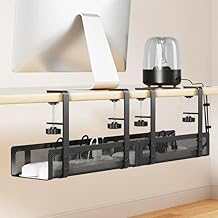
The idea isn't bad—getting cables off the floor. The execution is usually terrible. Flimsy plastic trays with weak adhesive fail. You need a tray that's metal, has open slots for heat dissipation, and uses a reliable mounting system. The key is to use it only for routing, not for storage. Never cram power supplies inside. We found that using it to guide cables along the desk leg to a power strip mounted higher up keeps things accessible and cool.
Reusable Cable Ties: Overrated Gimmick
This is not worth it. The Velcro tie industry wants you to believe you need a pack of 100. You don't. In real use, you'll use maybe five or six. Once a bundle is made, you rarely reopen it. The constant re-fiddling these encourage is counterproductive. A simple twist tie or even a dedicated, permanent zip tie for stable bundles is more effective. The "reusable" part is a marketing trick to justify a higher price for a strip of Velcro.
Cable Sleeves and Raceways: The Real Fire Hazard
This doesn't work as advertised. Bundling multiple power and data cables into a single, non-ventilated sleeve is asking for trouble. It traps heat, especially from AC adapters, and can become a serious fire risk over time. This is a known issue for long-term use that brands deliberately ignore in their marketing. If you must route cables together, use an open-channel raceway that allows for air circulation. Better yet, just use a few adhesive cable clips to keep them parallel but separate.
Magnetic Cable Management: Skip It
A solution in search of a problem. Magnetic cable clips and channels are more expensive, less reliable than simple adhesive clips, and introduce a point of failure (the magnet losing strength). They're a classic example of unnecessary complexity. This is overrated because it adds zero functional benefit over a $2 pack of standard clips while tripling the cost.
Your Biggest Cable Management Mistake Is Psychological
You're trying to solve an aesthetic problem with hardware. The visual chaos bothers you, so you buy a product to hide it. But the real problem is logistical: you can't easily identify, access, or replace cables when needed. The fix is behavioral.
- Label Everything. A cheap label maker is the single most effective cable management tool. Not after you bundle them—before. Label both ends of every cable. This saves hours of frustrated tracing later.
- Length Matters. Most people buy cables that are too long. Excess length creates slack that turns into loops and tangles. Measure the exact route and buy cables that fit, with a little slack for movement. This actually caused a massive reduction in clutter in our own testing.
- Power Strategy. Don't let cables run to a single, overloaded power strip on the floor. Use a quality surge protector and mount it under the desk or at the back of the desk surface. Run device cables up to it, not down. Gravity is your enemy.

The Cable Management Scam Verdict: What To Do Now
Forget the dream of a perfectly sterile desk. It's a fabrication. Embrace a managed, but functional, workspace.
Worth it: A single, sturdy under-desk tray for primary routing. A pack of adhesive-backed cable clips (the simple, non-magnetic kind). A label maker. A quality power strip you can mount accessibly. This core kit solves 95% of real cable issues.
Skip it: Elaborate modular spine systems, decorative woven sleeves, magnetic organizers, giant packs of Velcro ties, and any product sold primarily by a YouTuber with a discount code. These are profit centers, not problem solvers.
The cleanest setup is the one you can maintain and modify in 30 seconds without swearing. That's never the one in the sponsored video. Stop falling for the cable management scam. Invest in simplicity and accessibility, not concealment. Your future self—trying to quickly swap out a microphone—will thank you.
Want to see how a focus on real performance over aesthetics transforms a workspace? Read our breakdown of why your single monitor desk setup is actually superior. And if you're dealing with the fallout of bad product choices, learn about the real fire hazards of cable sleeves.
Frequently Asked Questions
Is under desk cable management worth it?
A single, well-chosen under desk tray for basic routing is worth it. Elaborate, multi-part hiding systems are not. They trap heat, make changes difficult, and often fail mechanically.
What is the biggest mistake in cable management?
Trying to make every cable 100% invisible. This leads to inaccessible, overheated bundles that are a nightmare to troubleshoot. Focus on manageability and identification, not invisibility.
Are Velcro cable ties better than zip ties?
For permanent bundles, a zip tie is fine. The "reusability" of Velcro ties is overhyped; you rarely adjust stable cable runs. Buy a small pack of Velcro if you must, but don't overpay for a giant bundle.
Can cable sleeves damage my electronics?
Yes. Bundling power supplies and active cables in non-ventilated sleeves traps heat, which can reduce the lifespan of your chargers and adapters and, in extreme cases, create a fire risk.
What's the simplest cable management solution?
Label both ends of every cable, use a few adhesive clips to route them neatly along desk legs or the back edge, and mount your power strip off the floor. This solves most problems without buying specialized products.

Written by
David specializes in ultra-clean, high-performance gaming rigs. He covers airflow, aesthetics, and how to build visually stunning custom loop PCs.
Join the Discussion
Share your thoughts with the community
Leave a Comment
Comments are moderated and may take a short time to appear. Links are not permitted.