Anti Fatigue Mat Thickness: 3/4 Inch Beats 1 Inch
Thickness is the spec everyone compares and almost nobody should optimize first. Here's why a dense 3/4-inch mat usually beats a cheap 1-inch one, and how to match depth to your floor, footwear, and desk geometry.

The most expensive mistake in this category is treating anti fatigue mat thickness like a scoreboard. Buyers assume 1 inch beats 3/4 inch beats 1/2 inch, grab the thickest mat on the shelf, and then wonder why their feet still ache by mid-afternoon. Thickness doesn't measure comfort. It measures how far the surface sits off your floor, which is a geometry problem before it's ever a comfort setting.
Here's the short answer. For a typical home office on carpet, LVP, or hardwood, wearing shoes or thick socks, 3/4 inch (roughly 19 mm) of polyurethane is the sweet spot. It's compliant enough to keep your feet and calves making small adjustments, firm enough that you don't wobble or trip. Half-inch mats are a legitimate budget option for one- to two-hour standing blocks. One-inch mats earn their money only on concrete or tile, or for heavier users standing six-plus hours a day.
The spec that actually decides whether a mat works is density, and most product listings bury it where nobody looks.
Why Anti Fatigue Mat Thickness Is a Variable, Not a Verdict
Standing still is not a neutral act. Prolonged static standing pools blood in your lower legs, and the ache that builds over an afternoon is your body asking you to move. The mechanism behind every anti-fatigue mat is the same: a slightly compliant surface forces constant micro-adjustments in your calves and foot arches, and that low-level muscle activity helps push venous blood back up toward your heart. Too hard, and there's nothing to work against. Too soft, and the surface props you up so completely that your stabilizers stop firing.
That's the whole trick, and it's why thickness has a ceiling. The ergonomics literature on prolonged standing broadly agrees that mats reduce reported discomfort in the feet, legs, and lower back compared with standing on a bare hard floor. It says far less about which thickness wins. Most studies compare a mat against no mat. Very few compare 25 mm against 19 mm. Anyone selling you a specific millimeter count as "clinically proven" is stretching the source material.
There's a second-order effect that never shows up in comfort scores: discomfort is an interruption. When your feet hurt, attention gets pulled toward them. Anyone who's tried to hold a long focus block together knows that four small interruptions cost more than the four minutes they consume. Getting the mat right isn't pampering. It's removing a recurring source of friction. That's the same logic behind our broader write-up on standing desk foot pain fixes that actually work, where the mat is one variable among several.
What thickness actually changes, physically:
- Standing height. A 1-inch mat raises you an inch. On a fixed-height counter or a shared desk, that's enough to shift your elbow and wrist angles by a few degrees.
- Balance demand. Thicker, softer surfaces require more ankle work to stay level. If your desk already shakes, fix that first, and our guide to making a standing desk stable without replacing it covers the cheap fixes. You don't want a spongy floor layered on top of a wobbly frame.
- Trip geometry. A 1-inch mat with a vertical edge is a step. The same mat with a 25-degree bevel is a ramp. That distinction matters more than the thickness number.
Five Specs That Separate a Mat That Lasts From One That Flattens
1. Thickness in millimeters, not adjectives. The standard increments are 12–13 mm (1/2 inch), 16 mm (5/8 inch), 19 mm (3/4 inch), and 25 mm (1 inch). Listings that only say "extra thick" are telling you they don't want you comparing. Metric numbers are also more reliable because some sellers round 18 mm up to "3/4 inch."
2. Density and compression set. This is the number that predicts whether the mat still works in year three. Density for flexible cellular urethane is typically measured under ASTM D3574, the standard test methods covering density and compression force deflection. What you'll see on spec sheets ranges from roughly 1.5 lb/ft³ for bargain closed-cell foam to 8 lb/ft³ for dense molded polyurethane. Anything under about 3 lb/ft³ will take a permanent dent where you stand. If a listing publishes no density at all, treat that as a signal and shop elsewhere.
3. Material chemistry. Four families dominate. Closed-cell PVC or EVA foam is cheap, stiff when cold, and flattens fastest. Polyurethane (PU) recovers better, weighs more, and costs more. Gel-filled mats feel plush for the first hour and can puncture or go stiff in a cold room. Nitrile or vinyl rubber is the workshop answer: heavier, stiffer, oil-resistant, and built for boots. None of these is universally better; they solve different problems.
4. Edge bevel geometry. Look for a 20–35 degree taper running at least 1.5 to 2 inches wide. A square edge on a 1-inch mat is a genuine trip hazard, and workplace safety programs commonly treat un-beveled mats that way. ASTM F1637, the standard practice for safe walking surfaces, is the reference point safety managers reach for when evaluating floor-level changes. At home, the practical version is simpler: if you can catch a toe on it, bevel it or buy one that is.
5. Top surface, backing, and footprint. A tacky, pebbled top grabs socks and bare feet. A diamond-textured top grips shoe soles but feels abrasive barefoot. The underside needs enough grip that the mat doesn't creep across hardwood. Size-wise, plan on at least 24 x 36 inches for a two-foot stance; 20 x 39 inches works in narrow gaps, and runners make sense at a fixed bench. Also check the shipping weight. A 1-inch PU mat in 24 x 36 can run 10–15 pounds, which you'll feel every time you move it.
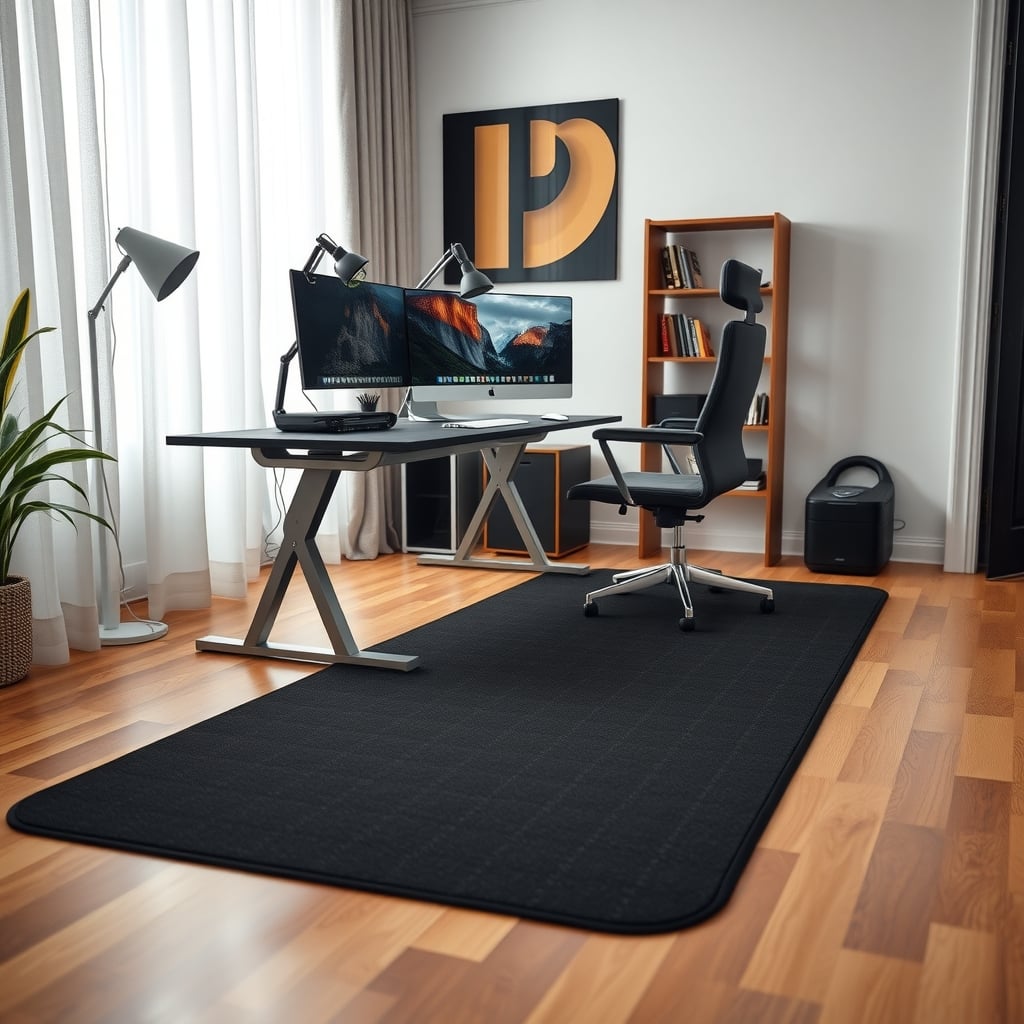
Anti fatigue mat thickness: what $35, $85, and $150 actually buy
Price tracks density far more than it tracks thickness. That's the single most useful mental model in this category. Thickness is a shape you choose for your floor; density is the budget line that decides how long the shape holds.
Best budget: 1/2-inch closed-cell PVC foam mat — $25–45 for a 24 x 36
Verdict: 6/10, and only for a specific buyer.
- 12–13 mm thick, typically 1.5–3 lb/ft³ density, closed-cell PVC or EVA
- Usually ships flat-edged or with a minimal taper, so check the bevel photo before buying
- Expect compression set in your standing spot within roughly a year of daily use
The honest case for this mat: if your standing blocks run 60 to 90 minutes and you stand on carpet, the physics works out fine. Carpet already adds compliance beneath the mat, so a thin top layer is often enough. The honest case against it: put this on tile and stand for four hours and you'll have a flat spot with a foot-shaped memory by month eight. This is a starter mat, not a decade mat. If you're choosing between this and a pair of cushioned insoles, the insoles will probably do more per dollar. If your pain is in the hips or lower back rather than the feet, the problem may not be the floor at all — our comparison of kneeling chairs versus standard office chairs covers when the seat is the real culprit.
Best overall: 3/4-inch polyurethane mat with a 20–30 degree bevel — $60–110
Verdict: 9/10 for most desk setups.
- 19 mm thick, generally 3–5 lb/ft³ PU, with a 1.5–2 inch tapered edge
- Recovery is the point: PU rebounds after load instead of taking a set, so the mat still feels like a mat at year three
- Warranties in this tier commonly run 3 to 10 years, which is the clearest signal of expected lifespan
This is the recommendation I'd defend in an argument. It sits in the range where your ankle doesn't have to fight the surface but your calves still get the micro-work that makes the mat do anything at all. It's thick enough to matter on hardwood or LVP, thin enough that you won't trip at the edge, and stiff enough that a rolling chair isn't immediately hopeless on it. The downsides are real and worth naming: it weighs roughly 6–10 pounds in a 24 x 36, it costs two to three times a budget foam mat, and it will still compress over years if you always stand in exactly the same six inches. Rotate your stance or rotate the mat 180 degrees every few months and you'll get noticeably more life out of it.
Best premium: 1-inch dual-density molded polyurethane — $140–220
Verdict: 8/10, but only if the conditions match.
- 25 mm thick with a dense base layer and a softer top layer, typically 5–8 lb/ft³ overall
- Molded edges are usually wider and gentler than trim-cut bevels, which matters on a 1-inch step
- Expect 10-year to lifetime warranty language in this tier
The dual-density construction is the reason to spend here. A dense bottom layer stops the mat from bottoming out on concrete, while the softer top layer provides the compliance. On a hard commercial floor with six or more hours of standing, this is genuinely better than a 3/4-inch mat in a way you can feel in week one. On home carpet, it's mostly wasted money. And the height creates real secondary problems: you're an inch taller than your desk assumes, the edge is a bigger trip risk even when beveled, and any rolling chair in the same footprint is now compromised. Buy this for concrete and long days. Skip it for a two-hour-a-day habit on carpet.
Barefoot, Boots, or Concrete: Matching Thickness to Substrate
Two archetypes cover the setups the three picks above miss.
Best for desk slippers and barefoot standing: 5/8-inch textured polyurethane — $60–90
Verdict: 8/10 for soft-floor setups.
- 16 mm thick, generally 3–4 lb/ft³, with a low, wide bevel
- Look for a fine pebble or leather-grain texture rather than a deep diamond tread, which is abrasive under bare feet
- Lighter than a 3/4-inch mat, usually 4–7 pounds
If you work in socks or barefoot, the difference between a 5/8-inch and a 3/4-inch mat is mostly about how much your arch sinks in. Barefoot contact spreads load over a smaller area, so a slightly thinner mat with a grippier top usually feels better than a thicker one you slide around on. The trade-off is lifespan: thinner PU has less material to compress. Expect this tier to be a three-to-five-year mat in daily use, not a ten-year one.
Best for concrete and boots: 1-inch nitrile rubber or vinyl workshop mat — $90–160
Verdict: 8/10 for garages, benches, and shop floors.
- 25 mm thick, roughly 4–7 lb/ft³, with a heavily beveled or ramped edge
- Oil- and chemical-resistant formulations are standard in this category; PVC foam is not
- Some versions include drainage channels, which are useful in a workshop and annoying in an office
The key difference here is stiffness, not thickness. On unpainted concrete, a soft PU mat sinks into the surface and you're effectively standing on concrete again by the end of the hour. A stiffer nitrile or vinyl mat spreads your weight across a wider area and doesn't bottom out. It won't feel plush. That's the point. This is also the tier where you'll find the heaviest mats on the market; a 3 x 5 runner in this class can exceed 25 pounds.
One more substrate note that catches people: carpet eats compliance. Put a 1/2-inch mat over a thick pile carpet and the carpet does the compressing, not the mat. In that situation, a denser 3/4-inch mat outperforms a thicker soft one every time. Density beats thickness on soft floors.

Five Mat Archetypes Side by Side
Archetype Thickness Density Material Edge Best for Street price (24 x 36) Typical warranty Budget foam 1/2 in (12–13 mm) 1.5–3 lb/ft³ Closed-cell PVC / EVA Flat or shallow taper 1–2 hour standing blocks, carpet $25–45 90 days – 1 yr Solid mid-range 3/4 in (19 mm) 3–5 lb/ft³ Polyurethane 20–30° bevel, 2 in taper Most home offices; carpet, LVP, hardwood $60–110 3–10 yrs Barefoot / sock-friendly 5/8 in (16 mm) 3–4 lb/ft³ Textured PU or gel-hybrid Low, wide bevel Socks or barefoot, up to 4 hrs standing $60��90 1–5 yrs Dual-density premium 1 in (25 mm) 5–8 lb/ft³ Molded dual-layer PU Full molded bevel Concrete, tile, 6+ hrs, heavier users $140–220 10 yrs – lifetime Workshop rubber 1 in (25 mm) 4–7 lb/ft³ Nitrile rubber or vinyl Ramped / drainage edge Garages, benches, boots, oils $90–160 3–10 yrsRead that table with one rule in mind: move down a row before you move across a column. Going from a 3/4-inch budget foam mat to a 1/2-inch dense PU mat is an upgrade. Going from a 3/4-inch dense PU mat to a cheap 1-inch foam mat is a downgrade, even though the number went up.
Mistakes That Make a Good Mat Feel Bad
1. Buying thickness without checking density. A 1-inch mat at 2 lb/ft³ bottoms out under a 180-pound person in seconds. A 1/2-inch mat at 5 lb/ft³ supports more. The fix: compare density first, thickness second.
2. Not re-saving your desk height presets. If your standing desk has memory presets and you buy a 3/4-inch mat, every saved position is now 3/4 inch too low. On a fixed-height counter you can't fix it, which is one reason thin mats win in shared spaces. The fix: measure the mat thickness with a ruler, add it to your standing preset, and re-save.
3. Expecting one mat to serve a rolling chair and a standing stance. Casters and thick mats don't cooperate. The mat creeps, the chair tilts, and cheap foam tears at the edge. The fix: keep a hard chair mat or bare floor under the desk and place the anti-fatigue mat at the front edge where you actually stand. If that's not possible, stay at 1/2 inch or thinner.
4. Wearing maximalist cushioning on top of the mat. Thick running shoes plus a soft mat equal double compliance, and your stabilizer muscles disengage from both. If you stand in heavily cushioned shoes, a firmer, thinner mat is usually the better pairing. Conversely, if you wear zero-drop minimalist shoes, the mat is doing more of the work and you can afford something softer.
5. Ignoring the bevel until you trip. Square edges are the single most common complaint in long-term reviews of thick mats. The fix: check the bevel angle in product photos before buying, and never place a 1-inch mat where you'll step onto it from the side.

Who Should Buy Which Thickness
Under $50 and standing less than two hours a day: a 1/2-inch closed-cell foam mat on carpet is a fine answer. Don't spend more until you know standing is a habit you'll keep.
Typical home office, carpet or LVP, shoes or thick socks: 3/4 inch polyurethane, 3–5 lb/ft³, beveled. This is the default recommendation and it covers the largest group of buyers.
All-day stander on hardwood, tile, or concrete: go up to 1 inch, but insist on 5 lb/ft³ or higher. Thickness without density is the mistake that makes people believe mats don't work.
Barefoot or sock-wearing: 5/8 inch with a grippy, fine-textured top. If foot and lower-leg fatigue is chronic rather than occasional, it's worth reading through how to avoid common standing desk health risks before you spend more on floor layers.
Garage, workshop, or bench with boots: 1-inch nitrile or vinyl rubber. Different product, different job.
Skip the mat entirely if: you stand for under 30 minutes at a stretch, your floor is already carpeted and you wear supportive shoes, or your pain is in the lower back rather than the feet. In those cases a mat is a $80 answer to a question you didn't ask.
Bottom Line
For most people, a 3/4-inch polyurethane mat with a 20–30 degree bevel and a published density of at least 3 lb/ft³ is the right purchase, and the $60–110 range is where that lives. Buy the dense 3/4-inch mat over the cheap 1-inch mat every time. If you're standing on concrete for six hours or more, step up to a 1-inch dual-density or rubber mat and accept the extra weight and height. If you're standing for an hour a day on carpet, buy the $35 foam mat, re-save your desk presets, and put the difference toward something that changes more of your day.
Frequently Asked Questions
Is a thicker anti-fatigue mat always better?
No. Thickness sets how far the surface sits off your floor, while density determines whether the mat still supports you after a year. A 3/4-inch polyurethane mat at 3-5 lb/ft3 outperforms a 1-inch closed-cell foam mat at 2 lb/ft3 in almost every real desk scenario. Thicker mats also add trip risk, weight, and standing height that may not match your desk.
How thick should an anti-fatigue mat be if I stand all day?
For six or more hours of standing on concrete or tile, 1 inch (25 mm) at 5-8 lb/ft3 is the sensible range, ideally with a dense base layer so the mat does not bottom out. On carpet or LVP with shorter standing blocks, 3/4 inch (19 mm) at 3-5 lb/ft3 is usually the better balance of support and stability.
Do I need to raise my standing desk after adding a mat?
Yes. A 3/4-inch mat raises you 3/4 inch, so every saved standing height on an adjustable desk is now too low. Measure the mat with a ruler, add that number to your standing preset, and re-save it. On fixed-height counters you cannot compensate, which is one reason thinner mats suit shared workstations.
Can I use an anti-fatigue mat under a rolling office chair?
It works poorly with anything thicker than about 1/2 inch. Casters make thick mats creep and curl, and soft foam tears at the edges. The practical setup is a hard chair mat or bare floor under the desk with the anti-fatigue mat positioned at the front edge where you actually stand.
How long should an anti-fatigue mat last?
Warranty length is the best available proxy. Budget closed-cell foam mats typically carry 90 days to 1 year and will take a permanent compression set within about a year of daily use. Mid-range polyurethane mats usually carry 3 to 10 years, and dual-density premium mats often carry 10 years or a lifetime guarantee. Rotating the mat 180 degrees every few months extends useful life meaningfully.
Do anti-fatigue mats help with plantar fasciitis?
Anti-fatigue mats are a comfort measure, not a treatment, and responses vary. Some people with plantar fasciitis do better on a firmer surface with supportive footwear rather than a soft, deeply compliant mat, because a very soft surface increases the load on the plantar fascia. If foot pain is persistent rather than end-of-day fatigue, treat the mat as one small variable and speak with a clinician.
Written by
GlowRig Editorial researches and writes practical guides about desk setups and home office gear. Our articles are produced with the help of AI research tools and are reviewed for accuracy against manufacturer specifications and public user feedback. We may earn a commission from affiliate links, which never affects our recommendations.
Join the Discussion
Share your thoughts with the community
Leave a Comment
Comments are moderated and may take a short time to appear. Links are not permitted.