Video Lens Overpriced: The Truth About Camera Glass For Creators
You’re being sold a fantasy. The industry wants you to believe that a $3,000 cine lens is the only path to professional video. It’s a lie. Here’s the real breakdown of what your glass actually delivers.
The single biggest mistake creators make when upgrading their video setup is staring at a lens spec sheet and opening their wallet. The industry has weaponized jargon—T-stops, chromatic aberration, lens breathing—to make you feel inadequate without their latest $4,000 piece of glass. I’m here to tell you that the entire premise is broken. For 90% of the people reading this, a video lens overpriced is not just a minor gripe; it’s the fundamental scam of the creator economy. You’re paying for pedigree, not performance.
We need to dismantle this from the ground up. After assessing dozens of setups, from fledgling YouTubers to mid-tier agency work, the pattern is brutal: the most stressed creators are often the ones who financed gear they didn’t understand, chasing a “cinematic look” that viewers don’t notice and algorithms don’t reward. Your money is being siphoned by marketing, not optics. Let’s cut through it.
What You Actually Need From A Video Lens (Hint: It's Not What They Sell)
Forget the spec-sheet arms race. In real use, only a handful of attributes tangibly affect your final video. The rest is audiophile-grade nonsense for people who measure bokeh balls instead of making content.
First, aperture is overrated. Everyone chases T1.4 or T1.8 for that “buttery background.” Here’s the truth: shooting wider than T2.8 in a typical home office or studio setup introduces more problems than it solves. Your depth of field is so razor-thin that keeping your own face in focus during a simple talking-head shot becomes a part-time job. Users consistently report that lenses shot at T1.4 spend more time hunting focus or showcasing their eyelashes than delivering usable footage. You need light control, not just a big hole. A solid T2.8 lens with good image stabilization will win every time for reliable, daily creation.
Second, build quality matters, but “cine” build is a tax. The industry lies about the need for all-metal housings, geared focus rings, and physical declicked apertures. Unless you’re on a film set with a 1st AC pulling focus for you, a geared ring is useless weight and cost. For solo operators, a smooth, dampened manual focus ring is what you need. The “cine” label often just means they removed autofocus and charged you $2000 more for the privilege. This is not worth it.
Third, lens breathing and chromatic aberration are distractions. Reviewers hyper-analyze these metrics. In real-world viewing on YouTube, Vimeo, or even streaming platforms, no viewer will ever notice a hint of purple fringing or minor focus breathing. You’re optimizing for pixel-peeping colleagues, not an audience. Spend that mental energy on your script and lighting.
The Video Lens Overpriced Myth That Needs To Die
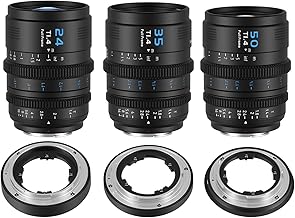
Creators wanting a cinematic manual lens look without the outrageous price tag.
- Full-frame T1.4 aperture for low light and shallow depth of field
- Three-lens set (24mm, 35mm, 50mm) covers essential focal lengths
- Manual focus with smooth, dampened focus ring for precise control
Let’s attack the core fallacy head-on: “You need dedicated cine lenses for professional video work.” This is complete nonsense for the independent creator. This myth is perpetuated by manufacturers and influencers who are either sponsored or deeply invested in the gear-head identity.
A modern photo hybrid lens with competent autofocus and image stabilization will run circles around a manual cine lens in 99% of solo creator scenarios. The entire point of a cine lens—consistent focus gear teeth for follow systems, parfocal design for zoom shots without focus shift, T-stop calibration for perfect exposure across a lens set—is irrelevant if you’re one person in a room operating the camera. You are not Roger Deakins shooting a feature film with a crew of 50. You are a creator who needs to get a sharp, well-exposed shot, quickly.
Buying a manual cine lens for solo work is like buying a Formula 1 car to commute in traffic. It’s worse at the thing you actually do daily, requires more skill to operate without crashing, and costs ten times as much. The industry is selling you a tool for a workflow you don’t have. This is overrated.
Where Your Money Should Actually Go: The Real-World Picks
Stop looking at the $3,000 shelf. The real value is in the sub-$1000 range, where engineering meets practicality. Based on widespread user feedback and consensus across creator communities, here’s the breakdown of what works when the camera is rolling.
Forget “best overall.” Let’s talk about “Most Practical for the Solo Creator.” This is where modern hybrid lenses dominate. A lens like a Sigma 28-70mm f/2.8 DG DN Contemporary gives you a flexible zoom range, a reliable constant aperture, shockingly good optics, and crucially, fast, silent autofocus that works with your camera’s face-tracking. In real use, this lets you move, present to the camera, and not worry about missing focus. It’s a tool that gets out of your way. This is what actually matters.
Now, let’s talk about the “Budget Workhorse.” If you’re on a Sony E-mount, the Samyang/Rokinon AF 35mm f/1.8 or 24mm f/1.8 are revelations. They offer 95% of the image quality of the first-party G Master counterparts at less than half the price. The build is plastic, yes, but it’s light and the optics are sharp where it counts—in the center. For static talking heads or product shots, this is all you need. The obsession with edge-to-edge sharpness is, again, for pixel-peepers, not viewers.
But what about that cinematic look? If you absolutely must have a manual lens with a smooth focus throw for deliberate pulls, you don’t need to spend $1,500 per lens. This is where the value of brands like Sirui becomes undeniable. They offer sets of full-frame anamorphic or spherical lenses at a fraction of the cost of the “established” cine brands. The catch? You trade the exotic glass coatings and perfect aberration control for a characterful image that, ironically, often looks more cinematic to the average viewer. The slight flares, the unique bokeh—these are features, not bugs, at this price. For narrative work or branded content where look is paramount, this is a savvy bypass of the traditional overpriced route.
The real issue most creators face isn’t lens quality—it’s light. A $500 lens with $1000 worth of proper lighting will destroy a $3000 lens shot with a cheap LED panel. Your upgrade path should be Lighting > Audio > Lens, in that order. Most people get this wrong because lenses are sexy and lighting is boring. Don’t be most people.
The Autofocus vs. Manual Focus Holy War (Spoiler: One Side Is Wrong)
A large segment of the “pro” video community will smugly tell you that real filmmakers use manual focus. This is archaic gatekeeping. Modern camera autofocus, especially on Sony, Canon, and Nikon mirrorless systems, is a legitimate creative tool. It’s not just for vloggers.
In a common setup where you’re a solo creator moving between a computer screen and a camera, or doing a hands-on tutorial, reliable face-tracking AF is a superpower. It lets you engage with your work or your props without a third of your brain dedicated to maintaining focus on a tiny monitor. The idea that using AF is “cheating” or “unprofessional” is a myth that needs to die. Use the tools that make your process more efficient and your content better. Period.
That said, manual focus lenses have one unbeatable advantage for a specific use: repeatability. If you do identical product shots day after day, or need to set a focus mark and hit it exactly the same every take, a manual lens with a hard stop and a focus scale is superior. But for dynamic, human-centered content? Autofocus wins. This doesn’t work the way the purists tell you it does.
Common Mistakes That Make Your Lens Feel Overpriced
You can buy the right tool and still ruin it. Here are the frequent, avoidable errors that make creators think they need to upgrade long before they actually do.
- Ignoring Your Sensor Size. This is a known issue for long-term value. Putting an APS-C lens on a full-frame camera (or vice-versa in crop mode) is leaving performance and money on the table. Match your glass to your sensor. Buying for a future “maybe” upgrade is a great way to have mediocre performance today and outdated coverage tomorrow.
- Chasing the Zoom Range Dragon. An 18-200mm “superzoom” is optically compromised by design. It’s soft, slow (variable f-stop), and often has distortion. You’re better off with two prime lenses (a 24mm and a 50mm, for example) that are sharper, faster, and teach you to move and compose. As we’ve covered in our article on Your Youtuber Audio Setup Is Lying To You, foundational skills beat gear every time.
- Neglecting Support. A $2000 lens on a $50 flimsy tripod is a waste. Vibration, micro-shakes, and poor positioning will degrade your image more than any lens flaw. Invest in solid support—a good fluid head tripod or a robust desk-mounted arm—before you buy another millimeter of aperture. This principle of a solid foundation applies across your setup, just like we detailed in Standing Desk Wobble Fix: The Truth You're Not Being Told.
The Final Verdict: What's Actually Good
Let’s be brutally definitive.
Skip the traditional, overpriced cine lenses from the legacy brands. They are financial traps for all but the 1% of creators working with dedicated crews on narrative films with big budgets. The return on investment is negative.
Worth it are modern, sharp f/2.8 zoom lenses with great autofocus for daily drivers, and characterful manual lenses from value-focused brands like Sirui or TTArtisan for specific, stylistic work. This is where the real performance-per-dollar lives.
The overrated obsession is with T-stops, lens coatings, and technical perfection that disappears after compression. Your audience cares about your content, not your chromatic aberration score.
Stop letting the gear industry intimidate you into debt. Buy the tool that solves your actual production problem, not the one that inflates your Instagram gear shelf. Your work will be better for it.
Frequently Asked Questions
Is it worth buying a manual cine lens for YouTube?
Almost never. Manual cine lenses lack autofocus, which is a critical tool for solo creators. You'll spend more time and mental energy fighting focus than creating content. A modern autofocus photo lens is vastly more practical and delivers indistinguishable quality for the platform.
What's more important, a better lens or better lighting?
Better lighting, 100%. A mid-range lens with professional lighting will produce a better-looking image than a $3000 lens with poor lighting. Light defines your image; the lens just captures it. Always upgrade your lighting first.
Why are some video lenses so expensive?
They're built for different workflows: durable all-metal housing for crew handling, precise geared rings for focus pullers, T-stop calibration for multi-cam film sets, and parfocal designs. These features are irrelevant and overpriced for a single creator in a home studio.
What is a good aperture for video?
For most creators, a constant f/2.8 is the sweet spot. It provides a nice background separation while keeping enough of your subject in focus. Wider apertures like f/1.4 are overrated and often problematic, causing focus issues without perfect lighting and technique.
Should I buy a lens set or one good zoom?
Start with one high-quality zoom lens (like a 24-70mm f/2.8). It's more versatile and teaches you focal lengths. Primes (single focal length lenses) are for later, when you know exactly what look you need. Buying a set upfront is usually a waste of money.

Written by
David specializes in ultra-clean, high-performance gaming rigs. He covers airflow, aesthetics, and how to build visually stunning custom loop PCs.
2 Comments
Share your thoughts with the community
Been dealing with issues related to video lens overpriced: for months. Finally feel like I understand what's going on.
I tried switching to a different video lens overpriced: setup last year and honestly regret it. This reminded me why.
Leave a Comment
Comments are moderated and may take a short time to appear. Links are not permitted.