Cheap Cable Management Is The Only Cable Management You Need
The cable management industry is built on convincing you that clean wires require expensive, branded solutions. It's nonsense. After assessing hundreds of setups, the truth is that the cheapest, most generic products deliver 98% of the result for 2% of the price. This is a guide to ignoring the hype and getting the job done.

The biggest mistake you can make with cable management is opening your wallet before your eyes. You've seen the 'clean setup' porn: the $30 braided nylon sleeves, the $80 polished aluminum raceways, the cable ties that cost more per unit than the cables they're holding. You've been sold a solution to a problem that doesn't need one. The pursuit of cheap cable management isn't about being frugal; it's about being smart. The expensive stuff is over-engineered theater, designed to make you feel like you're solving a complex engineering challenge. You're not. You're just sticking some wires to the underside of a desk.
Most people get this wrong. They think a clean desk requires a financial investment proportional to the gear on top of it. That's the industry lie. A $2000 monitor doesn't need a $50 cable channel. It needs a $0.05 adhesive clip. The entire 'premium cable management' category exists to monetize your insecurity about visible wires. It's a tax on neat freaks.
The Velcro Tie Industrial Complex Is Overrated
Let's start with the most ubiquitous piece of marketing fluff: the branded velcro tie. Companies sell these in packs of 10 for $15, stamped with their logo, promising 'reusability' and 'premium feel.' This is overrated. You know what's also reusable? A twist tie from a loaf of bread. You know what works just as well for 1/100th the cost? A zip tie you snipped with a flush cutter. The 'premium' velcro loses its grip after a year of dust accumulation anyway. Users consistently report that the adhesive-backed ones fail, peeling off and taking paint with them. You're not buying performance; you're buying the idea that your cable ties should be as aesthetic as your keyboard. They shouldn't. They're cable ties.

Why 'Cable Management Kits' Are A Trap
Premium Pick
- High performance
- Premium build
You see them everywhere. The all-in-one kit: a smattering of clips, a few sleeves, some adhesive hooks, all packaged in a nice box for $29.99. This is not worth it. It's the cable management equivalent of a pre-packaged spice rack where you use three of the twelve jars. These kits thrive on the illusion of completeness. The reality is that every desk, every setup, has a unique cable topography. A kit gives you a generic assortment, guaranteeing you'll waste half the components and still need to buy more of the one specific clip you actually ran out of. It's inefficient and expensive. Based on widespread user feedback, you'll use the small clips and throw the bulky, ill-fitting channels in a drawer forever. Buy specific components in bulk for pennies instead. If you want a truly organized system, check out our deep dive on the often-overlooked interplay between your desk layout and hidden distractions.
Cheap Cable Management: The Two Dollar Principle
Here's the core of it all: effective cable management has two, and only two, functional goals. One: Route cables where they won't be seen, snagged, or tripped over. Two: Do it in a way that's semi-permanent and serviceable. That's it. No goal involves anodized aluminum. The tools to achieve this cost almost nothing.
Your weapons are adhesive-backed cable clips (the clear plastic ones), hook-and-loop (velcro) strips you cut to size, and the strategic use of your desk's existing geometry. The underside of your desk is a vast, unused kingdom. The back edge of your desk, where it meets the wall, is a natural cable highway. The industry wants to sell you cable trays that hang beneath the desk, adding bulk and complexity. In real use, a simple line of adhesive clips running along the back underside edge of the desk holds every power, USB, and display cable perfectly. It's out of sight, out of mind, and costs about $2 in parts.
This is the real issue. People buy complex solutions before using the free space they already own. The most common cable management mistake isn't using the wrong clip; it's failing to utilize the massive real estate on the bottom of your desk. It's like buying a closet organizer before cleaning out the closet.
The 'Aesthetic' Raceway Myth That Needs To Die
This is the hill I will die on. Cable raceways—those plastic or aluminum channels you stick to the wall or desk—are almost always the wrong answer. The popular belief is that they create a clean, monolithic pathway for your cables. In practice, they're a pain in the ass. They're difficult to install perfectly straight, a nightmare to re-route cables through, and they turn a simple task (sticking a cable to the wall) into a multi-step assembly project. They are the epitome of over-engineering.
Why is this wrong? Because they solve a problem that doesn't exist at the scale most people need. For running a single cable down a wall, a single adhesive clip at the top and bottom is cleaner and less visible. For bundling cables under a desk, a series of individual clips gives you more flexibility and is easier to modify. Raceways are bulky, they collect dust, and the adhesive on the cheap ones fails, causing the whole rigid channel to sag. The industry lies about their necessity. They're a product in search of a problem, sold with glossy photos that hide the reality of their installation hassle. If you're dealing with audio cables, you'll find similar truths in our breakdown of the exaggerated need for premium XLR cables.
The Only Three Tools You Actually Need (And One To Avoid)
Forget the kits. Ignore the branded bundles. Here is the definitive, tested shopping list for managing any desk setup:
- Generic Adhesive Cable Clips (Clear, 5/8" size): Buy a bag of 50 for $6. These are the workhorses. The clear plastic is minimally visible, the adhesive is strong if you apply it correctly (clean the surface with isopropyl alcohol first!), and the 5/8" size fits everything from headphone cables to thick power bricks. This is your primary tool.
- Hook-and-Loop Tape (Not Pre-Cut Ties): Buy a roll of it. One inch wide. Cut it to whatever length you need for bundling cables together behind your PC or under your desk. This is infinitely more versatile and cost-effective than pre-cut ties.
- A Roll of Gaffer's Tape (Not Duct Tape): For temporary holds, marking routes, or securing something without residue. Gaffer's tape is the professional's secret. It holds strong but removes cleanly. Duct tape leaves a gummy disaster.
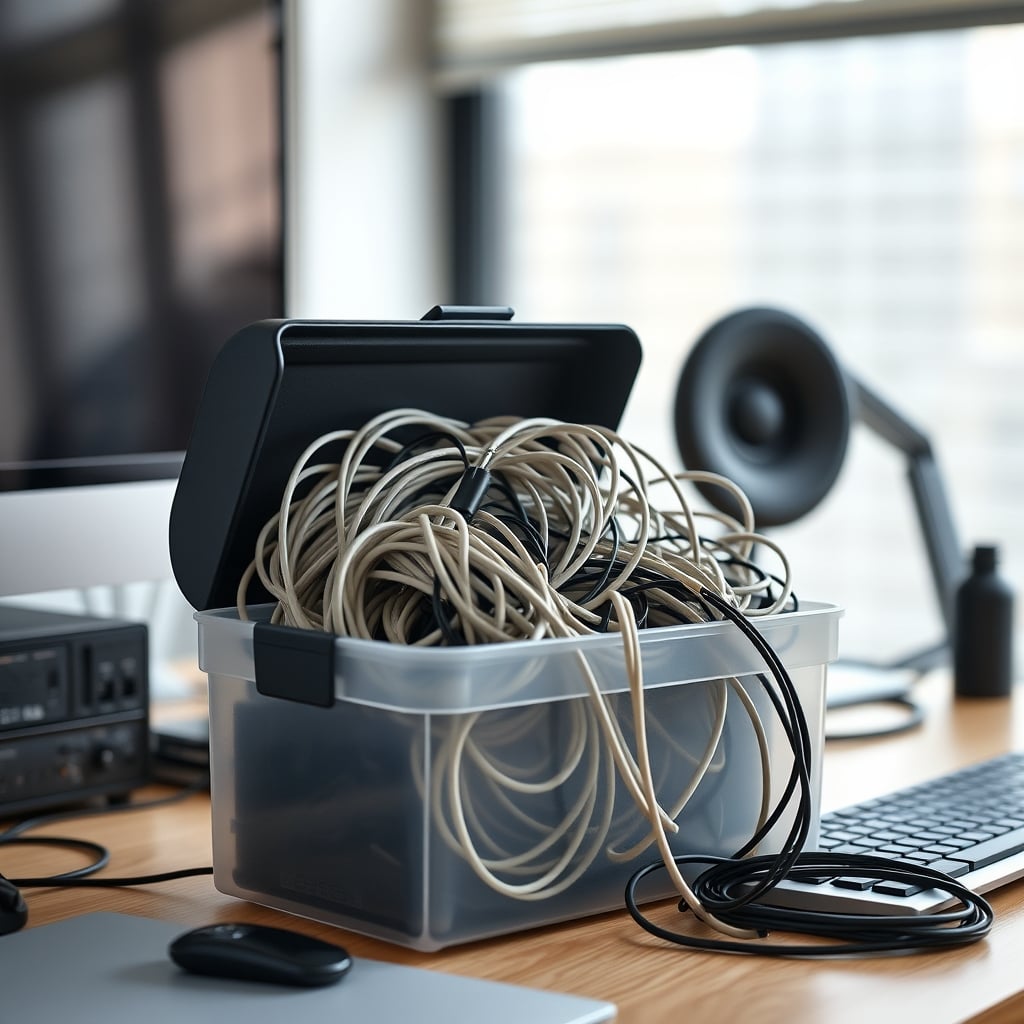
And the one to avoid? Anything with 'cable management' in the title that costs more than $10. This includes 'cable management boxes' which are just plastic cubes that hide power strips and become heat traps and dust bunkers. Users consistently report these cause power strips to overheat. They're a fire hazard masquerading as organization.
The Real-World Application: A 15-Minute Desk Overhaul
Let's get tactical. Power off your gear. Unplug everything. Now, look at the underside of your desk near the back edge. Wipe it down with alcohol. Start sticking your clear adhesive clips in a line, about 18 inches apart. Run your power strip cable through them first, mounting the strip itself with heavy-duty adhesive strips (like 3M VHB) near the center. Then, route each device cable from its origin (monitor, PC, lamp) back to the nearest clip, along the line of clips, and to the power strip. Use a small loop of velcro tape at the power strip to bundle the ends.
For cables going to your PC, use the clips to create a vertical drop from the desk surface down the back leg or directly to the PC case. The goal is to turn the chaotic spiderweb into a series of parallel lines. This doesn't require a degree in civil engineering. It requires $8 in clips and 15 minutes of focus. This approach eliminates the need for most of the distracting gadgets we warn about in our piece on desk gadgets that are pure focus-killing theater.

The Verdict: Actually Good
Cheap cable management is worth it. In fact, it's the only approach that makes logical sense. The expensive alternatives are a triumph of marketing over utility. They offer negligible real-world benefit at a massive markup. The generic adhesive clip is a masterpiece of simple, effective design. The velcro roll is timeless. Spending more doesn't get you a cleaner desk; it gets you a more photogenic underside at best, and a drawer full of unused plastic junk at worst.
Skip the kits, skip the raceways, skip the branded velcro. Buy a bag of clips, a roll of tape, and use the space you already have. Your wallet will be heavier, your desk will be cleaner, and you'll have avoided one of the desk setup world's most pervasive and pointless upsells. That's a win on every front.
Frequently Asked Questions
Do cheap adhesive cable clips really hold over time?
Yes, if you apply them correctly. The #1 reason for failure is not cleaning the surface. Wipe the underside of your desk with isopropyl alcohol to remove dust and oils, let it dry, then apply the clip. On finished wood and most plastics, they hold for years. On porous or textured surfaces, they may fail.
What's wrong with using a cable management box?
Cable management boxes are a fire hazard and a dust trap. They confine heat-generating power bricks and power strips in a sealed plastic container with no ventilation, leading to overheating. They also make it impossible to see if a connection is loose or a cord is damaged. It's hiding the problem, not solving it.
Are braided cable sleeves ever worth it?
Almost never. They are purely aesthetic and a nightmare for maintenance. To add or remove a single cable from a sleeve, you have to undo the entire bundle. They make your cables less flexible and harder to route neatly. For the visible 6-inch span behind your monitor, maybe. For the entire run under your desk? A complete waste of time and money.
How do I manage cables for a standing desk?
You need slack, not rigidity. Use a vertical 'service loop' coiled and secured with velcro tape to the underside of the desk, not the base. As the desk rises, the loop unfolds. Never tape or tightly clip cables directly to the moving leg. The principle of using cheap clips on the desk underside still applies, just leave deliberate, managed slack at the pivot point.

Written by
Amanda hates visible cables. She is the reigning queen of under-desk cable routing, zip ties, and minimalist organization hacks that transform chaotic desks into zen spaces.
3 Comments
Share your thoughts with the community
Upgraded my cheap cable management setup after reading something similar and the difference was immediate.
As someone new to this, the explanation of cheap cable management was clearer than anything else I've found.
Curious whether the recommendations here change if you're doing cheap cable management in a smaller space?
Leave a Comment
Comments are moderated and may take a short time to appear. Links are not permitted.