Clutter Tax Desk
Your desk isn't a workspace; it's a cognitive toll booth. Every extra gadget, every 'essential' cable, and every motivational trinket is charging you a Clutter Tax. We're exposing the real cost and showing you how to reclaim your focus in 2026.

Here’s the brutal truth nobody selling you desk gadgets wants you to hear: your desk is a failure. It’s not a productivity engine; it’s a billboard for your distraction, and you’re paying a heavy cognitive fee for every square inch of junk on it. We call this the Clutter Tax desk. If you haven't named your enemy, you can't defeat it. For years, we’ve been sold the lie that more gear equals more capability. A docking station for every port, a stand for every device, a RGB strip for every mood. It’s all marketing bullshit designed to make your desk look like a NASA control center while your actual output plummets. In 2026, the clutter tax isn't just about physical mess; it's about the mental bandwidth you hemorrhage every time your eyes land on that tangled charging cable or that notification light blinking for attention.
Most people get this completely wrong. They think a clean desk is about aesthetics. It’s not. It’s about cognitive warfare. Every item on your desk is a potential task switch, a memory trigger, a decision point you didn’t need to make. That funko pop? It’s a memory. That second monitor showing your inbox? It’s an anxiety generator. That clever cable management system you spent three hours installing? It’s a maintenance chore waiting to happen. We need to talk about the real, measurable drag this puts on your brain. This isn't Zen philosophy; it's performance engineering.

The Clutter Tax Isn't About Stuff, It's About Choices
The industry lies about this. They sell you 'organization' as the solution to clutter. A better tray, a smarter hub, a prettier drawer. This is overrated. You’re just polishing the chains of your distraction. The real clutter tax is levied in micro-decisions. Is my phone charging? Should I water that plant? Is that USB hub’s light too bright? Where did I put the dongle for the external drive? Each of these is a tiny cognitive withdrawal from your focus bank account. By the end of the day, you’re mentally bankrupt before you’ve even done the deep work.
Based on widespread user feedback, the single biggest source of the clutter tax in 2026 isn't paper—it's digital-physical hybrids. The wireless charger that needs aligning. The smart display showing redundant information. The stream deck with macros you forgot you programmed. These items promise efficiency but deliver friction. They create a layer of device management on top of your actual work. You’re no longer just writing a report; you’re also managing the ecosystem the report is written in. That’s the tax.
Why The "Productive" Desk Aesthetic Is A Scam
Premium Pick
- High performance
- Premium build
Walk into any setup tour from 2025 onward and you’ll see the same dystopian vision: eight monitors, three keyboards, a forest of microphone arms, and more RGB than a Times Square billboard. This is not a productivity setup; it's a performance of productivity. It’s designed for YouTube thumbnails, not for uninterrupted deep work. The clutter tax here is astronomical.
The lie is that all this gear makes you faster. In real use, it does the opposite. More monitors often lead to more context switching, not more space. Users consistently report that beyond two displays, the cognitive load of managing window placement and focus outweighs any marginal benefit. That third screen dedicated to Discord or Slack? That’s not a tool; it’s a siren song pulling you away from your work every thirty seconds. The clutter tax on your attention is the highest bill you'll pay.

The Myth of Modular Flexibility
Here’s a common myth that needs to die right now: Modular desk systems increase productivity. They don’t. They increase complexity. The promise is that you can swap out a monitor arm for a laptop stand, add a cup holder, clip on a headphone hook. The reality is you end up with a Frankenstein’s monster of aluminum and screws that rattles, collects dust, and creates a dozen new points of visual noise. Every clamp, every rail, every accessory is another item on your mental inventory.
This is overrated. You don’t need modularity; you need intentionality. Choose the tools for the job you actually do 90% of the time, not the job you aspire to do. That CNC-milled walnut monitor stand that holds one screen at a perfect 17-degree angle? If you only have one monitor, a simple riser does the same job for 1/10th the cost and zero mental overhead. The clutter tax isn't just financial; it's the mental energy spent choosing, installing, and maintaining all this ‘flexible’ gear. As we've covered in our piece on Desk Modular Systems Are Mostly Marketing Hype, the ROI is almost always negative.
The Clutter Tax Desk Audit: Your 2026 Intervention
Let’s get practical. You can’t fix what you don’t measure. Conduct a Clutter Tax audit. Take everything off your desk. I mean everything. Monitors, keyboards, plants, posters, the ‘inspirational’ coaster from that conference. Now, only put back what you physically touch to complete your primary, revenue-generating task. For most people, that’s: one computer, one keyboard, one mouse, one monitor. Maybe an audio interface if you record. That’s it.
Your phone? It doesn’t live on the desk. It’s a distraction device, not a work tool. Charge it elsewhere. Your notebook? If it’s not actively open to today’s page, it goes in a drawer. That collection of pens in the cute holder? You use one. Keep one. The rest are clutter tax collectors. This process will feel violent. Good. You’re performing surgery on a tumor of distraction.

The Invisible Clutter: Cables and Power
Physical objects are only half the battle. The true master of the clutter tax is your cable jungle. This isn't just ugly; it's a functional nightmare that sabotages workflow and creates a constant low-grade anxiety. You can have a clean desk surface, but if you glance down and see a rat's nest of black cables, your brain still registers chaos.
The common advice is to buy more organizers, clips, and sleeves. This is wrong. You don't need to manage cables; you need to eliminate them. Every cable represents a device, and you need to ask if that device deserves desk real estate. Can it be wireless? Can it be powered from a hidden hub under the desk? Can it be removed entirely?
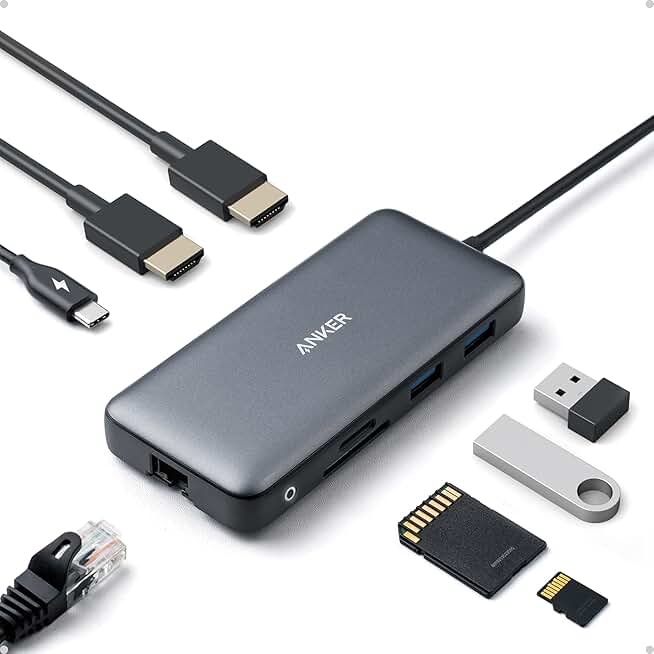
For the cables that remain, consolidation is your weapon. A single, high-quality docking station is worth ten cheap dongles. It reduces cable count, centralizes power, and cleans up the visual field immensely. But be warned: not all docks are created equal. Many introduce their own clutter tax through overheating, unreliable connections, or power throttling. Choose one that disappears into the workflow, like the Anker Nano 13-in-1, which consolidates a ridiculous number of ports into a single, clean connection point. It handles the mess so you don't have to think about it. For more on this approach, see our guide on Cable Management That Actually Works.
Digital Clutter: The Hidden 80% of Your Tax Bill
Your physical desk might be sparse, but if your digital desktop is a landfill of icons, sticky notes, and browser tabs, you're still paying the tax. This is the real issue most productivity gurus miss. Digital clutter creates the same cognitive drag as physical clutter. Every desktop icon is a decision. Every unsorted download folder is a tiny pit of anxiety. Every open tab is a reminder of unfinished business.
The fix is the same brutal intentionality. Your computer desktop is not a storage folder. It is a workspace. It should be empty. Use a launcher (like Raycast or Spotlight) to open apps and files. Archive or delete downloads weekly. Use a proper note-taking app instead of sticky notes that permanently litter your screen. And for the love of focus, use a tab suspender or manager. Thirty open tabs are not a sign of productivity; they're a sign of chronic indecision and task avoidance. Tackle this with the same ruthlessness as your physical space. Your brain will thank you.
The Final Verdict: Worth It
Purging the clutter tax from your desk is the single highest-ROI productivity intervention you can make in 2026. It costs nothing but willpower and delivers immediate, tangible results in focus, clarity, and reduced anxiety. You stop managing your environment and start dominating your work.
Skip the endless cycle of buying new organizers and 'productivity' gadgets. They're just new ways to pay the tax. Instead, invest in a few truly foundational, consolidating tools—a great dock, a simple monitor arm or stand, a wireless peripheral set—and then stop. The goal isn't a perfect Instagram desk. The goal is a desk that disappears, leaving only you and the work that matters. That’s a setup actually worth having.
Frequently Asked Questions
What exactly is the 'Clutter Tax' on a desk?
The Clutter Tax is the cognitive drain and continuous micro-distractions caused by every non-essential item on your desk. Each object—a gadget, a cable, a trinket—demands a tiny bit of your attention and decision-making energy, which adds up throughout the day and sabotages deep focus.
Is having a lot of monitors bad for productivity?
For most people, yes, beyond two monitors. The promise of more screen real estate is often outweighed by the increased cognitive load of managing multiple windows and contexts. It turns your workspace into a monitoring station instead of a focus zone. The marginal benefit is usually not worth the clutter tax on your attention.
What's the first thing I should remove from my desk?
Your smartphone. It's the single biggest source of intentional distraction. If you don't need it physically connected for a specific work task, charge it in another room. Its presence alone, even face-down, creates an anxiety to check notifications, levying a constant clutter tax.
Are expensive cable management solutions worth it?
Written by
GlowRig Editorial researches and writes practical guides about desk setups and home office gear. Our articles are produced with the help of AI research tools and are reviewed for accuracy against manufacturer specifications and public user feedback. We may earn a commission from affiliate links, which never affects our recommendations.
Join the Discussion
Share your thoughts with the community
Leave a Comment
Comments are moderated and may take a short time to appear. Links are not permitted.