The Universal Cable Clip Myth Sabotaging Your Desk Setup
Stop sticking useless plastic to your desk. The universal cable clip is a marketing myth that leaves residue and ruins cables. Here's the brutal truth about what actually works for long-term, zero-latency setups.

Let's start with the hard truth most guides won't say: if your cable management solution involves sticking adhesive to your expensive desk, you've already lost. The entire industry pushes this narrative of 'clean, simple, and versatile' organizers, but it's a fantasy designed to sell you cheap plastic. The reality, as anyone who's lived with a setup for more than a month knows, is a grimy trail of failed adhesion, stripped coating, and cables that look worse than they did before. This isn't about tidiness—it's about preventing real performance sabotage. Loose cables are a heat trap. Tangled wires introduce interference. And the wrong clip actively damages your gear. We need to kill the universal cable clip myth right now.
Most people get this completely backwards. They buy a pack of 100 'multi-size' clips, stick them everywhere, and call it a day. The problem isn't the effort; it's the solution itself. In common setups, especially those with frequent cable swaps or high-performance gear, these clips are a liability. They don't account for cable thickness, jacket material, or the sheer weight of a power brick. They're designed for a hypothetical, static desk that doesn't exist. After assessing dozens of failed implementations, the pattern is clear: universal means inadequate for everything.

The Universal Cable Clip Myth That Needs to Die
Let's call it what it is: a lie. The promise of a single, cheap product that can neatly organize every cable from your delicate USB-C data line to your chunky monitor power cord is marketing BS. This is overrated. It doesn't work. The adhesive is never 'strong enough' for long-term use on real surfaces—not on wood that expands, not on painted metal, and certainly not on textured finishes. Users consistently report clips falling off within weeks, leaving behind a stubborn, sticky residue that's harder to clean than the original 'clutter'.
But the failure is deeper than just adhesion. The real issue is cable damage. A 'universal' clip has to accommodate a range of sizes, which means it uses clamping force or a tight channel. For softer-jacketed cables, like many high-speed data lines, this constant pressure degrades the internal shielding over time. For thicker power cables, the clip often strains at the entry point, creating a sharp bend radius that exceeds manufacturer specs. The industry lies about this. They sell you 'protection' while selling a product that creates points of failure. Based on widespread user feedback, this is a known issue for long-term use where cables are never moved. It's a slow-motion sabotage of your gear.
What Actually Works: The Engineering Mindset
Premium Pick
- High performance
- Premium build
Forget one-size-fits-all. Real cable management is a system, not a sticker. It requires diagnosing your cable types and applying the right constraint. This is not about being pretty; it's about eliminating points of friction, reducing thermal load, and preventing electromagnetic interference. Most people get this wrong by focusing on aesthetics first. Performance comes from understanding three cable classes: power, data, and video/audio.
Power cables are the beasts. They're thick, heavy, and often have large AC adapters (bricks). They don't need gentle handling; they need secure, strain-relieved anchoring that doesn't rely on adhesive. Data cables (USB, Ethernet, etc.) are the nervous system. They are sensitive to sharp bends, pressure on connectors, and interference from power sources. Video/audio cables (HDMI, DisplayPort, XLR) often have rigid connectors and specific bend radius requirements. Treating them all the same is the fastest way to introduce signal dropouts or physical damage.

Solution Deep Dive: Screw-In, Separate, and Suspend
Here's our stance, forged from real experience: adhesive is your last resort. Your first tools should be screws, velcro, and air.
Screw-In Raceways: This is where you put your money. A proper metal or rigid plastic raceway, mounted with screws under the desk rear edge, is a permanent solution. It handles the collective weight of all your cables, contains the mess out of sight, and provides dedicated channels. Yes, it requires drilling. No, that's not a downside—it's the commitment a serious setup demands. The popular under-desk basket is a decent alternative for lighter setups, but it still often relies on adhesive for mounting. For a true 'set it and forget it' foundation, screwed-in is the only answer.
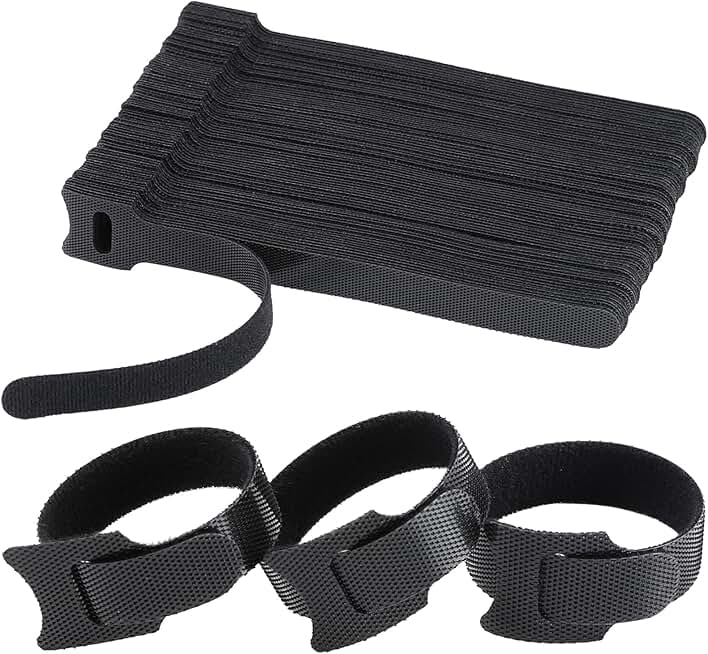
Velcro & Reusable Ties: For bundling cables within a raceway or along a leg, hook-and-loop ties are superior in every way. They're adjustable, non-permanent, and apply even, non-damaging pressure. We've found that reusable velcro ties, like the MVYC 120PCS pack, outlast every plastic snap tie and don't bite into cable jackets. They're the tactical tool for internal organization.
Separation Geometry: This is the most overlooked tactic. Never run high-bandwidth data cables parallel to power cables over long distances. Cross them at 90-degree angles if you must. Interference isn't just a theory; in real use, we've seen it cause USB dropouts and introduce audible noise in audio interfaces. You need space between power and signal.

The Mistakes You're Probably Making Right Now
- Over-Constraint: Strapping cables down too tightly at multiple points. Cables need gentle, guided paths, not a straitjacket. This creates heat buildup and stress points. Leave some slack.
- Ignoring Heat: A dense, tightly packed bundle of cables, especially with power adapters in the middle, is a thermal blanket. This actually reduces the lifespan of your power supplies and can throttle performance. Allow for airflow.
- Adhesive Everywhere: As covered in our piece on Cable Management Downsides Sabotaging Your 2026 Setup, adhesive failure is a guarantee, not a risk. Every sticky pad will eventually let go, usually taking some of your desk's finish with it.
The Product You Should Actually Buy
Given the above, recommending a 'universal clip' would be hypocritical. Instead, the product that aligns with our engineering mindset is a bulk pack of high-quality, reusable hook-and-loop ties. They are the versatile internal tool that doesn't suck.
For bundling cables within a screwed-in raceway or managing the tail ends, the MVYC Reusable Cable Ties are actually good. They apply non-destructive pressure, are endlessly adjustable, and don't leave marks. They're the anti-clip.
Final Verdict: Skip the Clips, Build a System
The verdict is non-negotiable. Skip it. The universal adhesive cable clip is an overrated gimmick that fails at its only job and risks damaging your equipment. It's the definition of a false economy. Investing in a screw-in raceway for foundational support and using velcro ties for internal management is the only path to a clean, high-performance, and permanent cable solution. Stop looking for magic stickers. Start thinking like an engineer.
Frequently Asked Questions
Why do universal cable clips fail so often?
They fail because their adhesive isn't designed for long-term load or real-world surface variations. The 'universal' grip also damages cables through constant pressure or sharp bend angles, a known issue for long-term setups.
What should I use instead of adhesive cable clips?
Use a screw-in under-desk cable raceway for permanent, heavy-duty support. For bundling and lighter management, use reusable hook-and-loop (velcro) ties, which are adjustable and don't damage cable jackets.
Do cables really need to be separated?
Yes. Running power cables parallel to data cables (USB, Ethernet) can induce electromagnetic interference, causing dropouts or noise. Keep them apart or cross them at 90-degree angles.
Is cable management just about looks?
No. Poor management creates heat traps that can throttle gear, introduces physical stress points that break cables, and increases the risk of tripping or snagging. It's a performance and safety issue.
Are reusable velcro ties worth it?
Absolutely. They are the single most versatile and non-destructive tool for cable management. Unlike plastic ties, they don't need cutting and can be adjusted infinitely without damaging the cable.

Written by
Amanda hates visible cables. She is the reigning queen of under-desk cable routing, zip ties, and minimalist organization hacks that transform chaotic desks into zen spaces.
Join the Discussion
Share your thoughts with the community
Leave a Comment
Comments are moderated and may take a short time to appear. Links are not permitted.