Plant Grow Light Distance Beats Watts Every Time
The gap between your light and your leaves is doing more work than the wattage printed on the box. Here's the distance range that actually fits desk plants, why the geometry beats the spec sheet, and what each price tier buys you at a fixed height.
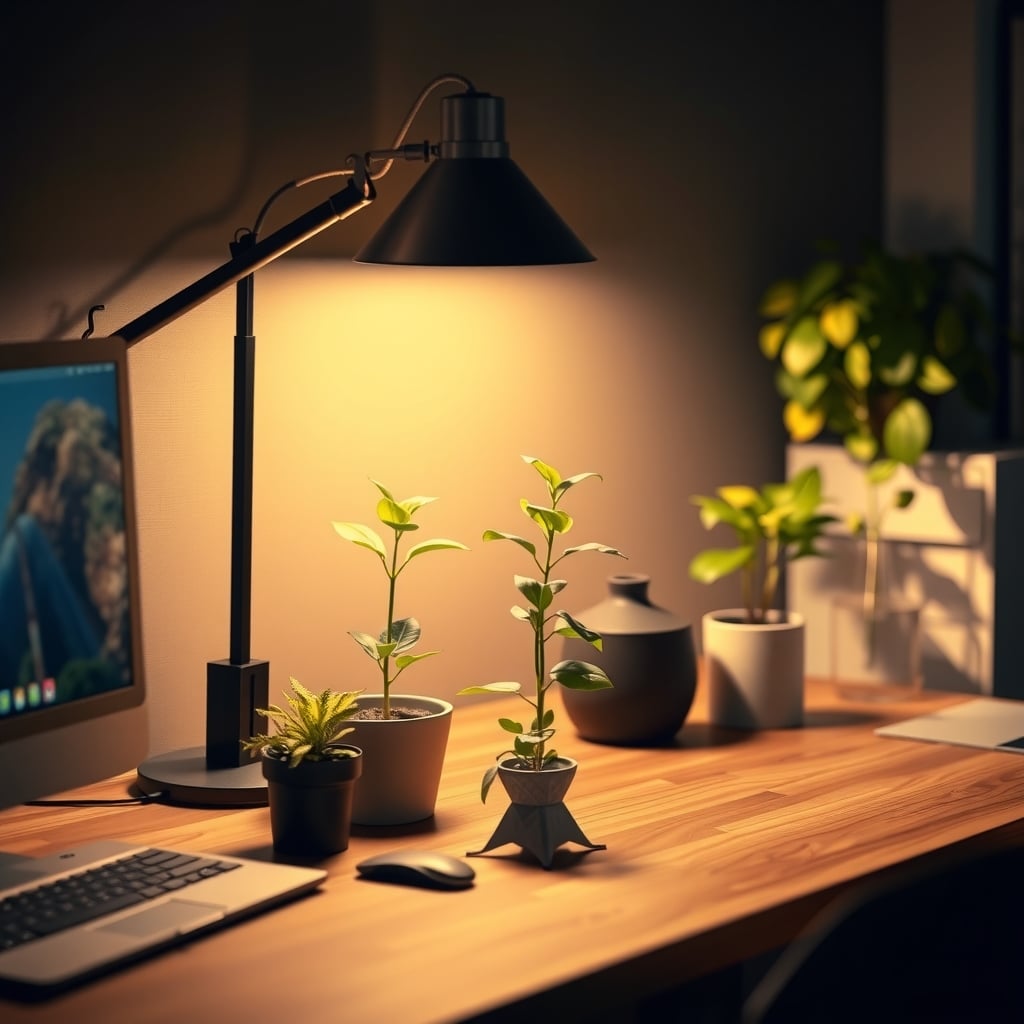
Short answer first: for most desk plants, the right plant grow light distance is 10 to 18 inches between the light's face and the topmost leaf. Low-light species — pothos, philodendron, ZZ plant — sit at the far end of that window. Herbs, seedlings, and succulents want the near end, closer to 6 to 10 inches.
The number isn't decoration. Light falls off with distance faster than most people assume, so the gap between your fixture and your foliage does more work than the wattage printed on the box. Get the distance right and a modest 20W light will outperform a 60W one hung three feet above the pot.
Why Distance Beats Wattage Every Time
Wattage tells you what the fixture pulls from the wall. It says nothing about how much of that energy becomes usable light, or how much of it survives the trip to your leaves.
Two fixtures both rated 20W can differ by more than double in photosynthetic output, because LED efficacy across the market runs from roughly 1.2 to 2.8 micromoles of light per joule of electricity. A well-engineered fixture converts more of its draw into photons; a cheap one converts a larger share into heat. The spec you actually want is PPFD — photosynthetic photon flux density — measured in µmol/m²/s at a stated height. If a listing doesn't publish PPFD at a distance, the wattage number is decoration.
Then there's geometry. A light source obeys the inverse square law: double the distance from a point source and you quarter the intensity. Real grow lights aren't point sources, and that's the part most guides skip. A long LED bar behaves more like a line source and loses intensity closer to linearly with distance. A broad panel loses less still. All three lose, but the shape of the falloff changes what "12 inches" means from one fixture to the next.
Leaves adapt, too. A plant grown at 18 inches develops thinner, larger, more shade-adapted leaves. The same plant moved to 6 inches overnight can scorch even when the light level is objectively fine for the species. If you're tightening the distance, do it in two-inch steps over a week or two. That acclimation window is the difference between a light upgrade and a light burn.
One more thing worth calibrating: white walls and a light-colored desk mat bounce a little light back up into the canopy. It's a real effect, but a small one — a few percent, not the 30% some packaging implies. Don't buy a reflective tent. Just don't paint the wall navy.
The practical upshot is that distance is the only variable you can tune for free. Before you upgrade a light, try lowering it four inches. That move is usually worth more than any spec upgrade you could buy.
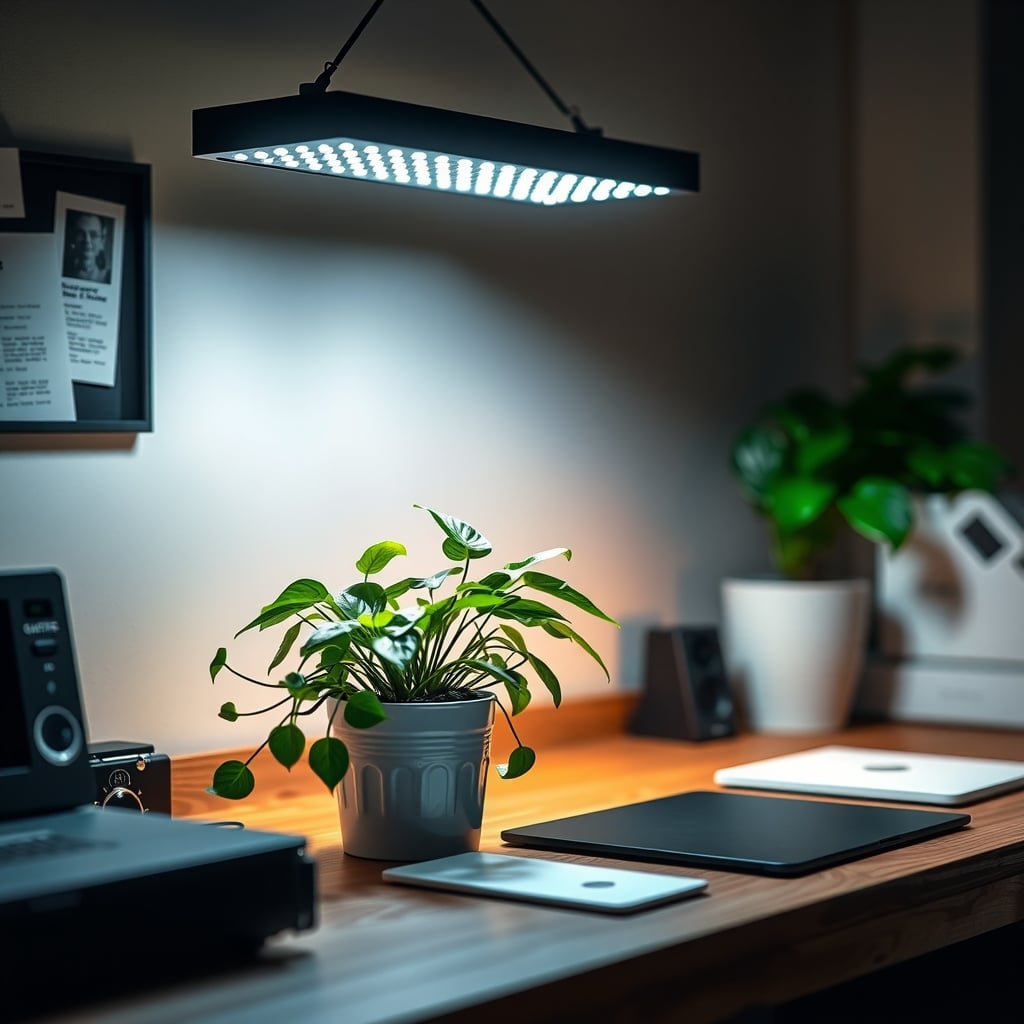
The plant grow light distance ranges that cover most desks
Treat these as starting points, not gospel. Plant age, leaf thickness, and how long the light runs each day all shift the sweet spot.
Distance to top leaf Intensity vs. 6 in (point-source math) What it suits 4 in ~2.3× Succulents, high-light herbs, hardened seedlings 6 in 1× baseline Basil, rosemary, tomato starts 10 in ~0.36× Succulents and flowering houseplants in forgiving setups 14 in ~0.18× Pothos, philodendron, monstera, most aroids 18 in ~0.11× ZZ plant, snake plant, cast iron plant 24 in ~0.06× Ambient glow, not growthThe right-hand column is rough horticulture consensus. The middle column is pure geometry — the point-source version, which overstates the drop for bar and panel fixtures. Real bars and panels lose less than the table implies, which is exactly why you shouldn't buy a fixture that only publishes a wattage figure.
Distance is measured from the light's emitting face to the highest point of the plant. Not the pot rim, not the soil line, not an average leaf height. The top leaf is the one that will scorch first, and it's the one setting the exposure for everything beneath it.
If you're still choosing which plants to put under that light in the first place, a low-light desk plant shortlist narrows the field fast — species that tolerate interior conditions genuinely don't need much hardware.
PPFD and DLI Without a Lab-Grade Meter
PPFD is the instantaneous rate of usable light hitting a surface. DLI — daily light integral, measured in mol/m²/day — is that rate integrated across your photoperiod, and it's the number that actually determines growth.
Here's the arithmetic, because it's easier than it sounds. Multiply PPFD by your hours of light, then by 3600 seconds per hour, then divide by one million. At 50 µmol/m²/s over 14 hours you land near 2.5 mol/m²/day. At 150 µmol/m²/s over the same window you land near 7.6.
University extension horticulture programs and indoor-growing references commonly put foliage houseplants in the 50–150 µmol/m²/s range for steady, healthy growth — roughly 2.5 to 8 mol/m²/day across a 12-to-14-hour photoperiod. Under about 20 µmol/m²/s, most plants hold on rather than grow. Past roughly 400–600 µmol/m²/s, shade-adapted species like pothos can bleach and scorch without a slow acclimation period.
Two things follow from that.
First, photoperiod matters as much as intensity. Twelve to fourteen hours on, ten to twelve off, is a sane default. Running lights 24/7 doesn't double growth — plants use the dark period for respiration, and a few species show stress from it. It also doubles what you spend on electricity.
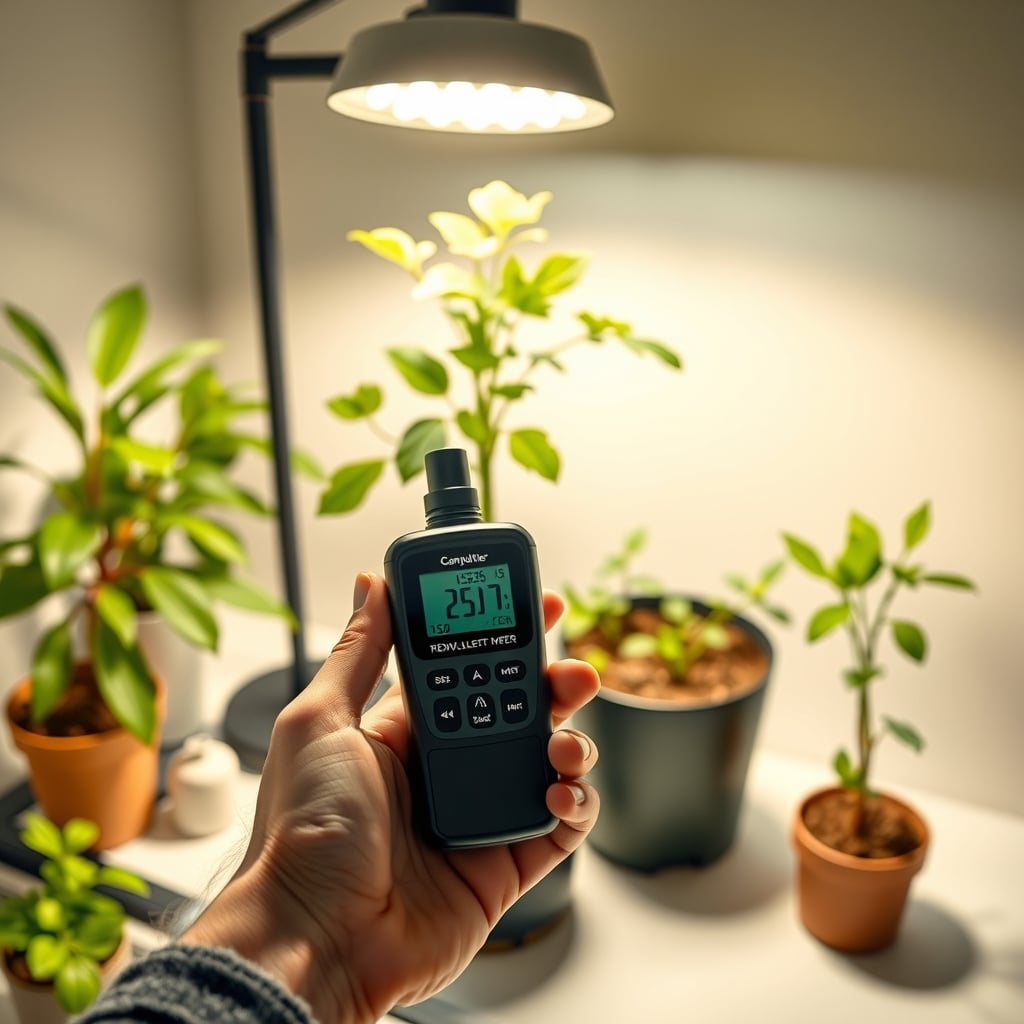
Second, cheap measurement is imperfect but not useless. Real quantum sensors start around $130–250 and use a filtered photodiode that responds only to photosynthetically active wavelengths. Your phone's camera-based lux app measures photopic light — weighted to human vision — which is related to PPFD but not the same thing. For white LED light, a rough conversion lands somewhere around 0.015 µmol/m²/s per lux, but that factor shifts with spectrum. Use a cheap lux meter to compare positions and heights against each other. Don't use it to claim an absolute PPFD number.
Cost reality check: a 20W fixture running 14 hours a day consumes 0.28 kWh. At a typical US residential rate, that's roughly $1.20 to $1.40 a month. Running two of them costs about the price of one coffee. If you've been holding off on a second light because of the power bill, the bill isn't the problem.
What $20, $50, and $150 Buy You at a Fixed Height
Prices below are realistic street prices as of late 2026, and they swing with sale cycles. What matters is what each tier gets you at a fixed 12 inches.
Tier Typical price Power draw Realistic usable height Timer and dimming Best for Single-head clamp light $15–30 10–20W 6–18 in Rarely both One pothos, one small shelf Dual-head clamp or desk grow lamp $30–60 20–40W 12–24 in Usually Two to four small plants on one desk Bar or low-profile panel $60–150 40–100W 18–36 in Yes A plant shelf or a full desk cluster Higher-output panel $150–300 100W+ 24–48 in Yes, plus better heat management Tall specimens, fruiting plants, propagation racksThe $15–30 tier is genuinely fine for a single pothos or snake plant on a north-facing desk. That's not a consolation prize — low-light species don't need much, and a 15W clamp light at eight inches covers one small plant adequately. What you don't get is dimming, decent heat management, or a timer you'd trust. Buy this if you have one plant and no window. Skip it if you're planning a shelf.
The $30–60 tier is where most desks land, and it's the sweet spot for a reason. You generally get two heads, a built-in timer, and some form of brightness control. Brightness control is the underrated feature here: it lets you run the light closer without scorching, which is exactly the trick that makes a cheap fixture punch above its price.
This is also the tier where aesthetics start to matter. A white full-spectrum fixture at 4000–5000K renders plants close to their true color. Blurple fixtures — blue plus red diodes — cast a magenta wash that makes every leaf look gray-purple and every photo look wrong. For a desk you actually sit at, buy white.
The $60–150 tier buys coverage and consistency. A bar or panel spreads light evenly across a 24-to-36-inch span instead of pooling it under a single head, which matters as soon as you have three or more plants. Higher PPFD also means you can hang it further away, so it stops crowding your monitor. The trade-off is real: these fixtures are visibly bigger, and the cheap end of this tier often ships with a noisy fan or a housing that runs genuinely hot. If the housing is uncomfortable to touch after an hour of operation, don't hang it within six inches of foliage.
Above $150, you're buying thermal engineering, accurate dimming, and honest published PPFD data. Legitimate for a propagation rack or a tall monstera. Overkill for two pothos on a credenza.
One non-negotiable at every tier: look for a UL or ETL listing on the fixture. Grow lights run long hours, often unattended, sometimes near paper and fabric on a desk. Unlisted imports are a real electrical risk, and the listing mark is the cheapest insurance in this entire category.
Six Distance Mistakes That Quietly Stall Growth
1. Measuring to the pot instead of the canopy. A six-inch gap at the soil line can be eighteen inches from the top leaf on a leggy pothos. Fix: always measure to the highest point of foliage, and remeasure monthly — a fast grower can close two or three inches in a few weeks.
2. Assuming more watts means more light at the leaf. A 60W fixture hung 30 inches up can deliver less usable light than a 20W fixture at 12 inches. Fix: if the listing publishes PPFD at a height, use that. If it only publishes watts, treat the purchase as a gamble and keep the light adjustable.
3. Running 24 hours to compensate for weak intensity. This is the most common self-defeating move. Plants need a dark period, electricity costs double, and extra hours can't fix a fixture that's simply too far away. Fix: 12 to 14 hours, and lower the light.
4. Never moving the light as the plant grows. A fixture that sat perfectly at 14 inches in March might be 5 inches from new growth by June. Fix: check distance whenever you water. Etiolation — long, stretched stems with wide gaps between leaves and smaller-than-normal foliage — means too little light. Bleached, crispy, or upward-curling leaf edges mean too much.
5. Buying blurple for a desk you look at. Color rendering, not plant response, is the issue. Blue-plus-red fixtures work for photosynthesis but flatten plant color into gray-purple and wash your workspace in magenta. Fix: full-spectrum white at 4000–5000K. It also pairs far better with the rest of your desk lighting — the same principle behind keeping a desk lamp from flaring across your monitor applies here.
6. Ignoring the heat envelope. Distance isn't only about photons. At four inches, a warm-running panel can push leaf temperature past what the plant tolerates, which shows up as marginal browning that looks like underwatering. Fix: if the housing is hot to the touch, move it up and increase intensity instead.
Matching Your Desk to the Light It Actually Gets
Window orientation changes the answer more than any product choice.
A south-facing window in the northern hemisphere can push direct sun three or four feet into a room at midday. Plants in that path often need no supplemental light at all from spring through fall. A grow light there is redundant, and probably scorching.
An east window gives gentle morning sun, which most aroids love. A west window gives aggressive afternoon heat. Both deliver usable light within about two to three feet of the glass, and both fall off sharply beyond that.
North-facing windows are the classic case for a grow light. They deliver consistent, indirect, low-intensity light — beautiful for viewing, not much for growth. This is where a 20–40W white fixture at 12 to 16 inches earns its place.
The gotcha almost nobody accounts for: a window's useful range collapses in winter. At higher latitudes, sun angle and daylight hours drop enough that a spot which grew aggressively in July becomes a maintenance-only position by December. If your plants stall every winter, that's not a watering problem.
Distance from the glass matters in both directions. Three feet away from a bright window, you're in the same category as an interior wall. If you can't move the desk, add the light.
Lighting temperature is worth matching, too. A 4000–5000K grow light sits in the same family as most neutral desk lamps, so the two don't fight each other visually. Pair it thoughtfully with your room's ambient contrast rather than treating it as a separate appliance.
Who Should Buy a Grow Light and Who Should Skip It
Buy one if: your desk is more than three feet from any window, your only window faces north, you keep plants in a basement or windowless office, or your plants visibly stall every winter.
Skip it if: your plants sit within two feet of a south or west window that gets several hours of direct sun. In that spot a grow light at any distance is more likely to scorch than help. Also skip it if you only keep ZZ plant and snake plant and you're content with slow, minimal growth — those species genuinely tolerate interior conditions, and no fixture changes how much you enjoy them.
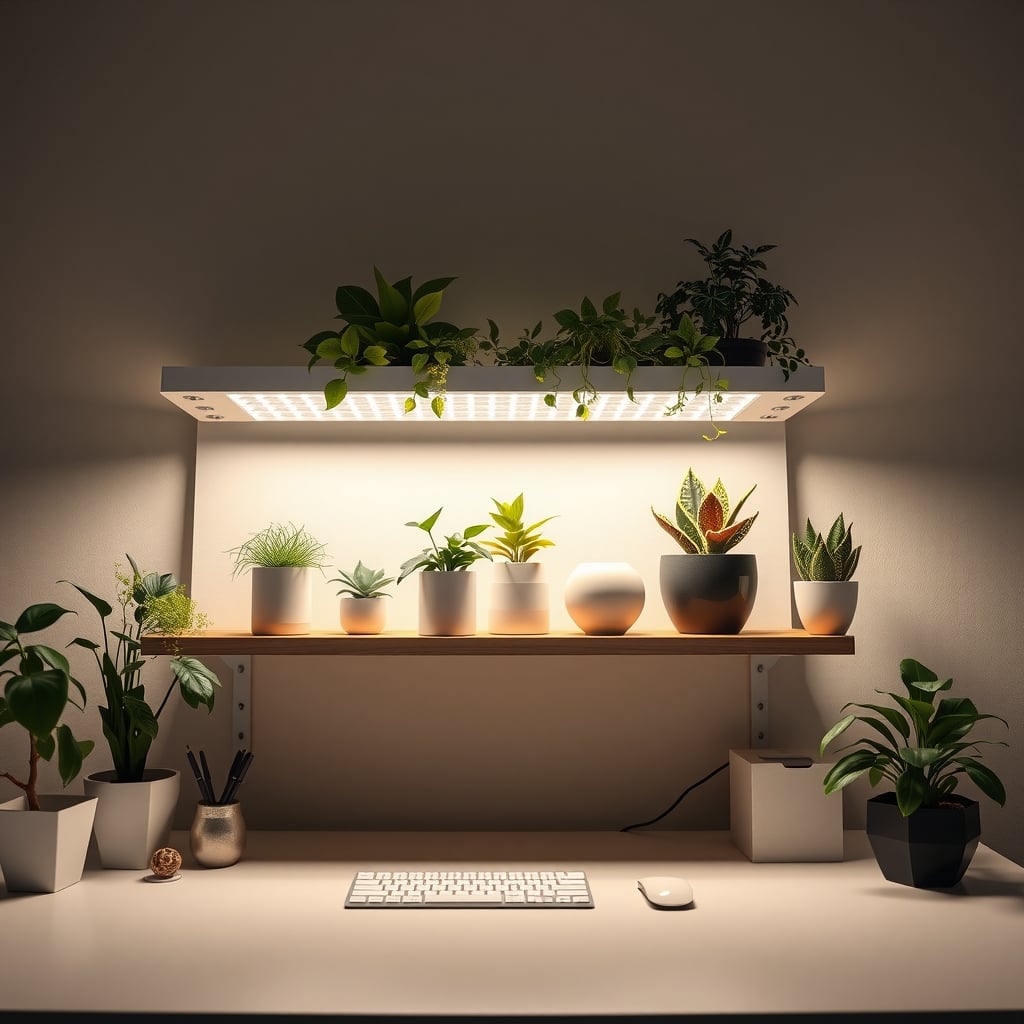
Budget guidance, stated plainly. For one or two small plants, a $30–50 dual-head white clamp light with dimming is the right call. Don't spend more. For a shelf or three-plus plants, a $70–120 bar is worth the step up, because coverage — not peak intensity — is what you're buying. Only go above $150 if you're growing fruiting plants, running a propagation rack, or need published PPFD data to hit a specific DLI.
Skip the automation upgrade unless you'll actually use it. A timer is essential. App control and schedules are pleasant but not load-bearing for a single fixture. Smart lighting setups make more sense when you're coordinating several lights across a room, and then the schedule becomes the whole point.
The Bottom Line
Start at 12 inches from the light face to the top leaf. Run it 12 to 14 hours a day. Then adjust based on what the plant does, not what the box claims — stretched, pale growth means lower the fixture; bleached or curling edges mean raise it.
Buy white full-spectrum, not blurple. Look for a UL or ETL listing. Look for published PPFD at a stated height, and treat wattage alone as an incomplete spec. For a single desk plant, a $30–50 dimmable clamp light at 10 to 14 inches will do everything a $200 panel would do in that position. For a shelf, buy coverage instead of peak output.
And if you take one thing from this: the fixture you already own is probably too high. Drop it four inches before you spend anything.
Frequently Asked Questions
How far should a grow light be from a pothos?
For most setups, 12 to 18 inches from the light's emitting face to the top leaf works well for pothos and similar aroids. Low-output clamp lights may need to sit closer, around 8 to 12 inches, while a high-output panel can hang further away. Measure to the highest point of foliage, not the pot rim.
Can a grow light be too close to a plant?
Yes. Under roughly 4 inches, both heat and excessive PPFD can damage shade-adapted species. Warning signs include bleached or washed-out leaf color, crispy brown edges, and leaves curling upward. Raise the fixture and lower intensity rather than removing the light entirely.
Is running a grow light 24 hours a day bad for plants?
Most plants need a dark period for respiration, so continuous light rarely improves growth and doubles electricity use. A 12-to-14-hour photoperiod with 10 to 12 hours of darkness is a workable default for foliage houseplants.
How do I measure plant grow light distance correctly?
Measure straight down from the light's emitting face to the highest point of the plant canopy. Measuring to the soil line or the pot rim overstates the gap on leggy plants and is the most common reason a light underperforms.
Do I need a PPFD meter for desk plants?
Not unless you're dialing in a specific daily light integral. Quantum sensors with filtered photodiodes typically run $130 to $250. A $20 to $30 lux meter can compare one position against another relatively well, but it measures photopic light, so it can't give you an absolute PPFD figure.
What color grow light is best for a desk setup?
White full-spectrum light in the 4000 to 5000K range. Blue-plus-red blurple fixtures photosynthesize fine but render plants and your workspace in a magenta-gray cast, which is a poor fit for a desk you sit at and photograph.
Written by
GlowRig Editorial researches and writes practical guides about desk setups and home office gear. Our articles are produced with the help of AI research tools and are reviewed for accuracy against manufacturer specifications and public user feedback. We may earn a commission from affiliate links, which never affects our recommendations.
Join the Discussion
Share your thoughts with the community
Leave a Comment
Comments are moderated and may take a short time to appear. Links are not permitted.